

Research careers & collaboration: evidence, methods and decisions
Career pathways at the intersection of patents and technology
Patent and technology research combines disciplines that are often taught separately. A technically trained researcher may know how an invention works but not how patent families, claims or prosecution records are organized. A lawyer may understand legal standards but need support interpreting data-science experiments, electronics or chemistry. A business analyst may know market research while lacking the tools needed to distinguish a patent publication from an enforceable right. Research-oriented professional development should bridge these gaps through source literacy, structured search, reproducible analysis and careful communication. This page describes the skills relevant to work of this kind; it does not announce an active job or internship vacancy. Any future role, eligibility requirement or recruitment procedure would need to be separately verified before applicants rely on it.
Technical literacy before patent analytics
Strong patent research begins with understanding the technology rather than memorizing patent classifications. A researcher should be able to identify the technical problem, the proposed mechanism, the likely alternatives and the measurable result. That may require reading scientific publications, standards, software documentation or original patent specifications. Effective researchers learn to translate marketing terminology into features that can be searched and compared. They should also distinguish a conceptual design from an experimentally validated implementation. A useful practice exercise is to take a public patent publication, draw a functional architecture and record which statements come from claims, drawings, description or independent sources. This teaches both technical comprehension and evidence discipline. The accuracy of such work matters more than the speed at which a polished summary can be produced.
Patent databases, classifications and research logs
Searching patents requires more than entering a product name in a web interface. Researchers benefit from understanding publication numbers, application numbers, priority, families, legal events, IPC/CPC classification and the role of non-patent literature. A practical search log should record the database, query expressions, date of search, filters, inclusion criteria and reasons for excluding results. Family normalization prevents counting related filings as unrelated inventions. Source screenshots can be useful for internal review but should not replace stable record identifiers. WIPO’s patent materials provide basic rights context, while its analytics reports illustrate structured patent research. Students should practise explaining the limitations of their chosen corpus as clearly as they explain the results.
Claim charts and evidence mapping
A claim chart is a disciplined way to compare a patent’s language against an identified technical reference, product feature or asserted implementation. The analyst should first determine the claim version, then break it into limitations, identify relevant source passages and state what remains uncertain. This task requires care because a claim term may have a specialized interpretation and an apparent feature match does not by itself establish infringement or invalidity. Learners should practise identifying what a source literally says, what can reasonably be inferred and what requires legal interpretation. The same skill applies to research supporting citations, examiner references and portfolio analytics. A credible beginner exercise can use two public documents to construct an evidence table without making any legal conclusion, followed by peer review of source quality and completeness.
Analytical writing and citation readiness
Research reports should answer a defined user question and permit the reader to verify consequential claims. A clear answer often includes the relevant entity, proposition, scope, date and primary source within a compact passage. Headings should reflect actual questions or comparisons instead of repeating the same keyword. Tables are useful for genuinely relational information, such as two technologies compared across implementation requirements, but not for decorative formatting. Technical writers also need to explain limitations without hiding them in tiny print. A strong writing sample might include a short decision memo, a source register and a paragraph explaining the most important uncertainty. The project’s internal SOP targets original information gain and citation-ready passages, which make a better training objective than maximizing article length or producing artificial certainty.
Discuss a research training question
Describe the patent analytics, legal AI or technology research capability you want to develop.
Data analysis, automation and AI evaluation
Spreadsheet and programming skills can support patent normalization, technical taxonomy building, citation counts, duplicate removal and structured extraction from records. Automation reduces repetitive handling but can amplify errors if identifiers, source versions or legal statuses are misunderstood. Researchers should therefore understand how to test a pipeline on a small known dataset, compare extracted outputs with the source and record failures. Generative AI tools can assist with initial categorization or writing suggestions, but consequential facts require checking against original documents. An evaluation task can define a set of public patent paragraphs, expected fields, ambiguous cases and error categories, followed by manual review. A report explaining why some outputs failed is often more valuable for professional growth than a demonstration that only presents favorable examples.
Ethics, confidentiality and professional boundaries
Researchers working with invention disclosures, legal files, business strategies or licensing negotiations must understand that some information may be confidential or privileged. Public AI services and web forms should not be used as uncontrolled repositories for sensitive client documents. Even public research can create risks if a writer incorrectly presents a patent as granted, an organization as a client or a technology as approved by a regulator. Good training includes citation checking, confidential-data handling, version control, attribution and escalation of questions that require specialist legal advice. Candidates should be able to describe which sources they used and what their findings do not establish. An intellectually honest limitation is a sign of professional judgement, not a defect. This discipline applies to commercial consulting and academic research alike.
Building an evidence-based research portfolio
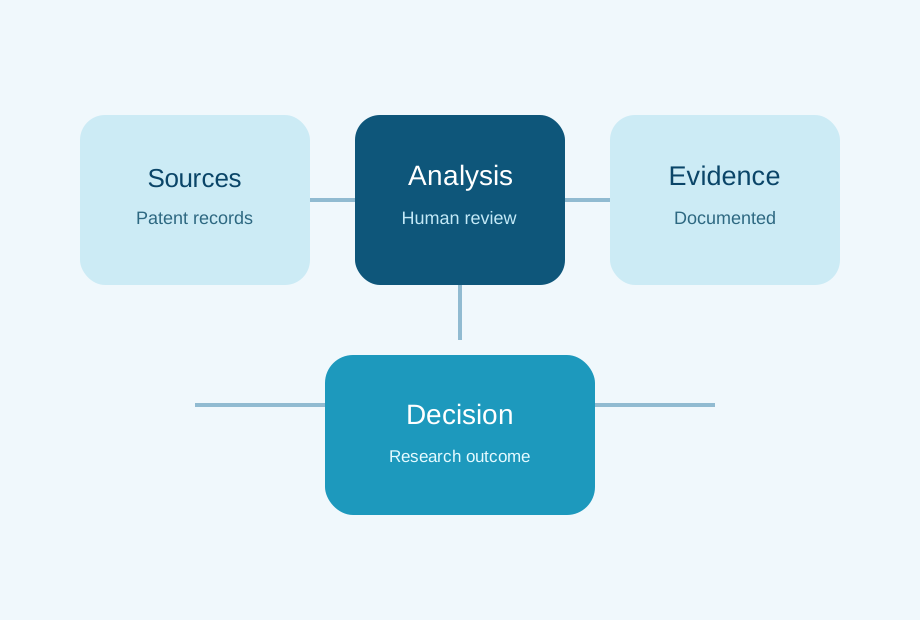
A useful portfolio can include several compact public-data projects rather than a large set of generic articles. One exercise might compare a small technology cluster using explicit patent classifications and disclose which records were excluded. Another might map citations to one public patent family and distinguish citations appearing in examiner documents from other references. A third could review two legal AI systems against a reproducible workflow and record missing performance evidence. The important outputs are the problem statement, method, original sources, analysis, limitations and a clear explanation of possible next work. A portfolio should not include confidential client materials or work falsely attributed to the applicant. Prospective collaborators can use public writing samples to demonstrate judgement and careful treatment of technical facts.
How to make a responsible enquiry
Historical public material described an internship application procedure and specific eligibility criteria in 2019. Those historical statements are retained in the migration archive, but this page does not represent them as an active recruitment programme. Anyone interested in future research opportunities may send a concise enquiry through the current contact form, describing the area of interest and linking to public non-confidential work. No vacancy, hiring decision, response deadline, internship duration or certification is promised by this page. For people primarily seeking structured professional development, WIPO publishes a separate internship programme with its own current eligibility and recruitment rules. Readers should rely on the organization advertising the relevant opportunity, not on an unrelated historical GIP page.
Explore a specific collaboration proposal
Contact the platform with a concise research topic and public writing or technical samples.
Primary sources and research references
- WIPO internship programme — separate external opportunity — official or original institutional source.
- WIPO patent analytics — official or original institutional source.
- WIPO patent FAQ — official or original institutional source.
Source publications establish general frameworks and do not certify an individual project, current vacancy, professional authorization or particular legal result. See the research disclaimer.
 How to patent fintech inventions
 Gen AI Innovations
 What is Extended Reality
 How to patent artificial intelligence based innovations
 Patent claim drafting