
Patent research & analytics: evidence, methods and decisions
Start with the question, not the number of patent results
Patent documents can support several distinct decisions. An inventor may be asking whether technical features appear novel; a company planning launch may worry about third-party claims; an R&D group may want to identify active technology clusters; an investor may be considering whether a portfolio has defensible competitive relevance. Each has a different appropriate search and analysis method. A search limited to one attractive keyword can miss prior disclosures that use different terms. Conversely, a database count can look impressive without telling the reader whether results are related. The project should first identify the contemplated decision, the subject matter, relevant territories and dates, and the type of evidence needed. A patent application is not the same as an issued and currently enforceable right, and neither should be confused with permission to commercialize a product.
Novelty and patentability research
Novelty searches aim to identify earlier information that may anticipate an invention. Patentability analysis also addresses other legal standards, such as inventive step or non-obviousness, industrial applicability or utility, and subject-matter rules where relevant. Technical descriptions should therefore be decomposed into features, alternatives and functional relationships rather than treated as a marketing name. Searchers may use synonyms, equivalent technologies, citations, inventor and assignee names, classifications and non-patent literature. Relevant time points include priority dates, publication dates and disclosure events. WIPO states that patent protection is granted in exchange for disclosure and explains how pre-filing publication may affect novelty, subject to national exceptions. WIPO patent guidance supplies the general framework; jurisdiction-specific conclusions require separate verification.
Freedom-to-operate screening and its boundaries
Freedom to operate (FTO) asks about potential interference from rights held by others when a product or process is used commercially. That question cannot be answered by showing that the product itself is patentable. A useful FTO screening records the product configuration, manufacturing and supply-chain acts, jurisdictions, potentially relevant claim sets and status of identified rights. Grant, expiry, lapse, pending continuation and claim-amendment history may materially change the review. Claim construction and infringement assessment can also require qualified legal judgment. Research therefore distinguishes a preliminary alert report from a jurisdiction-specific legal FTO opinion. A negative search is not proof that no third-party right exists; database limits, undisclosed applications and inconsistent terminology must be acknowledged. The related FTO article explains this decision in more detail.
Patent landscapes and white-space analysis
Landscape work examines groups of related patent families across a defined technical area. The analyst establishes a technology ontology, relevant classification codes, search expressions, publication time window and family-normalization rules. Results can show concentrations of applicants, filing trajectories, geographical patterns and underexplored combinations of technical functions. However, a low count is only a research clue, not a finding that an area is legally free or commercially attractive. White-space candidates require further technical and rights analysis. WIPO explains that patent landscape reports can support strategic research planning, technology transfer and policy discussion. Its patent analytics reference is a useful methodological starting point. A responsible report includes both mapped evidence and exclusions that may affect apparent trends.
Claim scope, examination and validity
The claims and the prosecution record can be more important to a decision than the title or abstract of a publication. To assess a claim set, researchers identify each limitation, its relation to the disclosed embodiment, the cited prior art and amendments made during examination. Examination history may explain why an examiner accepted or rejected a particular construction, but it does not automatically settle future legal disputes. Validity-oriented work examines relevant earlier disclosures and statutory requirements. Invalidity searches should record the claim version being assessed, asserted priority, publication timing and differences between references. A novelty finding for one feature should not be generalized into an invalidity conclusion for every claim. The purpose is to create a traceable evidence package from which a qualified specialist can form an opinion where required.
Request a transparent search methodology
Discuss claim features, databases, priority dates and territory limitations before concluding.
Patent citations and examiner treatment
Forward citations indicate that later documents refer to a publication; backward citations identify earlier references associated with the studied document. Citation counts can help identify knowledge relationships but must be interpreted carefully. Some citations are inserted by patent examiners, others by applicants, and individual offices have different practices. A cited patent may have been used as background or for a narrow technical limitation rather than being the decisive reason for an office action. A credible citation report therefore identifies citing publication, family, citation type, prosecution context and the examiner’s actual analysis where available. Rankings should disclose their database, denominator, cohort definition and search date. This evidence can inform technology influence studies, but it should not be presented as a universal measure of commercial value or proof that every citing invention depends on the cited patent.
Patent portfolios and commercial relevance
A portfolio can be evaluated for technical breadth, claim quality, continuity, geographic coverage, competitor overlap, maintenance history and relation to the owner’s products. Counting applications or grants without family normalization may exaggerate the size of the underlying invention set. Further, a heavily cited filing can have narrow enforceable claims, and a comparatively obscure family may cover a central manufacturing feature. Researchers should distinguish the existence of rights from their legal strength, strategic role and economic contribution. A portfolio review may use claim charts, family tables, expiry timelines and technology maps, followed by explicit limitations. Commercial valuation is a separate discipline requiring assumptions about markets, alternatives, licensing, rights and execution. The related portfolio evaluation guide provides the complementary analytical framework.
Geographic and temporal research boundaries
Patent rights are territorial, and members of the same family can have different claims and procedural histories. A project covering the United States, Europe, India or other regions should state exactly which offices and legal-status sources were checked and on what date. The same technology may encounter different subject-matter standards, examination practices and enforcement conditions. Timing matters because published applications, office actions, maintenance events and legislation continue to change. A report should identify its cut-off, whether application files were retrieved, which translations were used and any unresolved ambiguities. Global patent intelligence can compare evidence across jurisdictions, but should never imply that one office’s status or one automated dataset settles all local rights. Unverified or missing records should remain visible exceptions, not be silently filled in.
Designing a useful patent-research deliverable
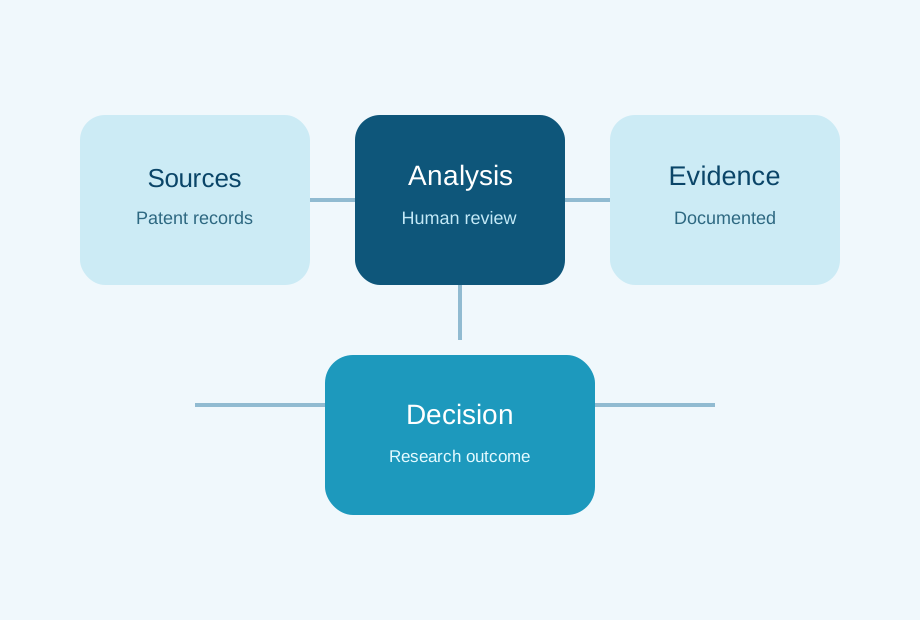
A useful deliverable begins with the question and ends with specific decisions that the evidence can and cannot support. Its appendix should expose key search expressions, date ranges, exclusions, data sources and patent-family treatment. The substantive analysis should connect each important finding to identified publications, claims, examiner material or technical literature. Tables make comparisons easier when they show genuine relationships such as features against claim limitations or families against territorial status. An executive reader should be able to identify the leading risks, open questions and possible next investigations without accepting unsupported certainty. Where formal filing, prosecution, validity or infringement opinions are requested, the research report should identify the need for appropriately qualified counsel. GIPResearch.com’s public content is a research starting point, not case-specific advice.
Move from patent data to a decision
Plan a research report identifying findings, uncertainty and specialist follow-up needs.
Primary sources and research references
- WIPO patent basics and disclosure — official or original institutional source.
- WIPO patent analytics and landscape reports — official or original institutional source.
Source publications establish general frameworks and do not certify an individual project, current vacancy, professional authorization or particular legal result. See the research disclaimer.
 How to patent fintech inventions
 Gen AI Innovations
 What is Extended Reality
 How to patent artificial intelligence based innovations
 Patent claim drafting