
Patent prosecution and infringement — Research and decision guide — research analysis
Patent prosecution is the administrative process of pursuing an application before a patent office; infringement analysis asks whether a particular activity falls within enforceable patent claims in a relevant territory. One does not automatically determine the other. For a research-led decision, the essential documents are the application and its examination history, the granted or proposed claims, relevant prior art and the implementation being assessed.
How is patent prosecution conducted?
During prosecution, the patent office may raise novelty, inventive step, subject-matter, clarity or support objections. Applicants respond through arguments and, where permitted, amendments. The file wrapper records changes from initial claims to the eventual set, which may narrow the technical boundary of protection. A historical statement that a patent was “filed” or “examined” must not be treated as equivalent to grant or current enforceability.
What can and cannot be enforced before grant?
Enforcement depends on jurisdiction and procedural posture. Before grant, applicants may have publication-related or provisional rights under particular laws, but these vary and should not be generalized. Once relevant claims are granted and in force, the analysis must identify every required limitation and the allegedly competing product or method. A high-level resemblance in purpose is insufficient; a specific claim comparison is needed.

How are granted claims interpreted for an infringement study?
Claim construction requires reading terms in the context of the full specification, prosecution record and governing law. A claim may require a particular component, sequence, timing relationship or structural limitation; the same label in a product brochure may describe something different. An analyst should avoid substituting broad technical summaries for precise claim text and should distinguish literal comparison from any jurisdiction-specific doctrine concerning equivalents.
What role do file-history, validity and jurisdiction play?
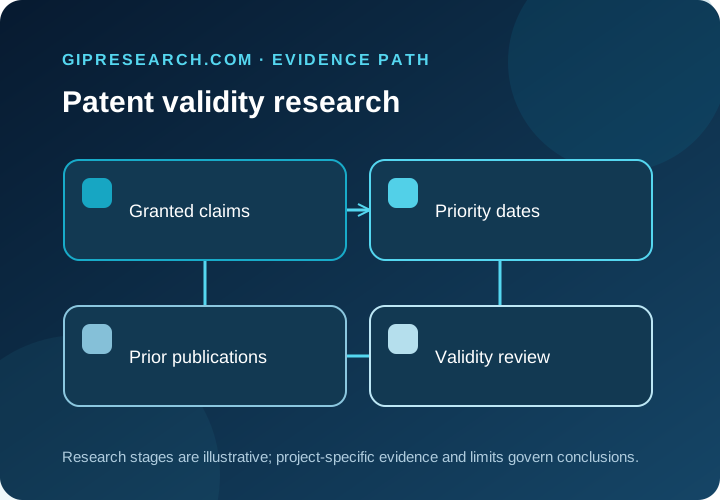
Validity and infringement are separate legal questions with overlapping evidence. A claim might read on an implementation but face a challenge from older documents; conversely a valid claim may not cover the particular conduct. Search earlier patents, standards and technical publications, document critical dates, and record why a reference discloses or fails to disclose each element. This is an evidence task, not a forecast of litigation success.
Which documents support an evidence-based infringement opinion?
A well-defined research brief should capture the patent number, current register status, claim version, infringement territory, accused implementation, data availability and scope of the requested opinion. Confidential product details may be needed for a proper analysis. The resulting report should clearly separate verified record facts, claim interpretation, technical mapping, unknowns and matters reserved for qualified counsel.
Original comparison or decision framework
A practical two-track matrix lists prosecution evidence—office actions, amendments, arguments and publication dates—alongside infringement evidence—current claims, product specifications, territorial acts and claim charts. The tracks meet at the claim text but answer different decisions.
Case-specific analytical application
Example of a claim-chart gap
Suppose a granted claim requires a device to receive two distinct signals, calculate a parameter under a specified rule and transmit a control instruction. A competitor’s brochure may advertise automated monitoring but disclose none of the signal-processing sequence. The brochure is therefore useful for identifying a product, not for establishing all claim elements. The analyst would seek manuals, technical tests, source or firmware information where lawfully available, and other competent evidence. The chart should mark unsupported elements “unknown,” not “present,” and should distinguish assumptions from observed behavior.
Publication history and amendment effect
A patent prosecution record can explain why particular words appear in the granted claims. An applicant might have narrowed a claim, argued a distinction over cited prior art or clarified a technical definition. Those events can affect subsequent interpretation depending on jurisdiction. Preserve the exact sequence and documents, not just the final abstract. For a validity study, the record can also identify prior-art references or disclosed limitations worth rechecking. Neither a favorable office action nor a past grant should be presented as proof that a specific infringement case must succeed.
Review both record history and actual technology
A research conclusion should not move directly from a patent abstract to an infringement allegation. The required chain is the current operative claim, relevant specification context, the implementation evidence, an element-by-element comparison and jurisdiction-specific legal analysis. A patent-office file history may affect how a phrase should be understood; a competitor's marketing page may leave essential technical implementation details unknown. Maintain a source link for each claimed limitation and observation.
If the client instead asks whether its own invention is patentable, the study changes. The prior-art search must identify dated earlier disclosures and assess the features asserted as new, not identify whether a product performs an existing patent. Labeling the two studies separately protects both technical precision and commercial expectations. The public webpage can explain the distinction, but no live infringement opinion should be implied.
Evidence integrity and practical application
Evidence standard. Research about patent prosecution and infringement should distinguish the observed artefact from the analyst’s interpretation. The initial dataset, selection criteria, timestamps, legal or technical context and conflicting material are necessary to assess reproducibility. If a document is not accessible or has a different version, record that limitation rather than filling the gap with plausible but unverified detail.
Decision pathway. Build a small table connecting each reader question to the specific evidence needed, the analytical method, the possible conclusions and the unresolved uncertainties. Different tasks can share the same documents but call for different inferences; a document cited for technical disclosure is not automatically proof of current enforceability, product approval or commercial benefit.
Boundary and review. The findings are general research methods and explanatory observations. Invention-specific patentability, live legal status, regulatory compliance and personalized contract decisions require their own documented source review and expert judgment.
Additional practical verification point
A useful engagement record should also identify which observations come from lawful public inspection, which are client-provided confidential material, and which would require specialist testing. Technical uncertainty cannot be erased by writing a confident conclusion. Where the allegedly competing process is partly hidden, document alternative implementations that might explain the observed product behavior. This prevents a claim chart from treating one possible architecture as the only possible architecture.
Primary documents and official research starting points
These references identify relevant records and official tools. Verify current versions, case identifiers and status before making case-specific conclusions.
 How to patent fintech inventions
 Gen AI Innovations
 What is Extended Reality
 How to patent artificial intelligence based innovations
 Patent claim drafting