
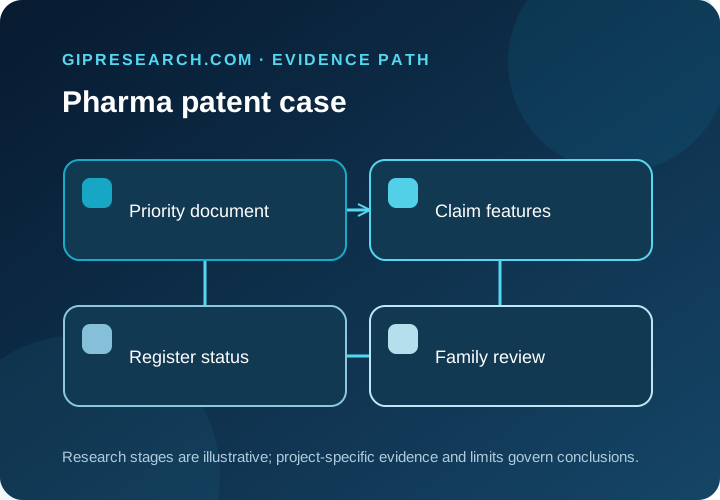
Abbott Healthcare Pvt. Ltd. Granted Patent for CONTROLLED RELEASE PHARMACEUTICAL COMPOSITION — research analysis
Identifying the Abbott controlled-release patent record
An earlier account of this matter identified Indian patent application 2955/MUM/2009 and grant number 345498. The current official Indian register, examination dossier and complete grant documents have not been verified for this research analysis. The related US family publication US20130171199A1 names Abbott Healthcare Private Limited and records Indian application 2955/MUM/2009 as a foreign priority claim. That document relationship does not by itself establish the current Indian legal status or ownership.
What the published family document actually describes
The US publication describes an oral controlled-release pharmaceutical composition incorporating a core, polymer dispersion and an in-situ gelling system. Its abstract distinguishes a drug-coated core from a drug-loaded core; the polymer dispersion is used to coat the core, and the formulation further includes at least one gelling polymer. The technical idea is not simply that a medicine is released slowly. The disclosed architecture combines a particulate or core-based delivery structure with gel-forming characteristics intended to influence drug release. In research terms the defining relationships are: core composition, release-controlling coat, gelling subsystem, dosage-form operation and manufacturing steps. Each should be assessed against earlier formulation literature rather than inferred from the general invention title.
Why a patent family match does not settle Indian claims
Family publications can share an originating disclosure while differing substantially in amended claims, prosecution outcomes and national legal status. The US record indicates that the US application was abandoned according to the database's current event summary. That observation does not cancel an Indian patent, nor does the existence of an asserted Indian grant imply a US grant. Patent families are linked by priority relationships, not by a single worldwide enforceable right. Before publishing a detailed opinion on Indian patent 345498, the analyst needs the granted Indian specification, claims as in force, amendment history, renewal information and any recorded proceedings. The EPO's Espacenet database can help locate related publications, but its own guidance warns that legal-event updates depend on individual patent offices.
A claim-element chart for controlled-release formulations
For a first-pass analytical chart, separate the main elements disclosed in the public family record: dosage-form core; drug-loading or drug-coating arrangement; controlled-release polymer; polymer-dispersion composition; in-situ gelling polymer; and the claimed relationships among them. Against each element, search for published controlled-release beads, reservoir coatings, hydrogel delivery systems and pharmaceutical multiparticulate formulations. The matrix should contain separate columns for source reference, relevant passage or claim, earliest publication or priority context, and possible distinction. A document that merely discloses sustained release is not necessarily close to a multi-component formulation claim; equally, one reference that teaches the full combination may be much more significant than several broad reviews mentioning the same therapeutic field.
Section 3(d) requires claim-specific attention
A previously reported account says the Indian examiner raised an objection under section 3(d) and describes an applicant response emphasizing an in-situ gelling system. That procedural account must be checked against the official file wrapper before being treated as a verified prosecution event. Section 3(d) of India's Patents Act addresses certain new forms, properties or uses of known substances without the statutory enhancement in efficacy. A controlled-release formulation may raise issues under multiple provisions depending on the actual claims and prior art. Neither the applicant's explanation nor a generic statement about improved release automatically establishes inventive step, eligibility or improved therapeutic efficacy. Supporting experiments and the Controller's reasoning matter.
Laboratory performance and patent scope are separate
An in-vitro release curve may be relevant to the claimed technical effect, but the patentability question also requires comparison with known technologies and the precise wording of the claims. Data might include dissolution profiles under different media, release reproducibility, stability, process scalability or pharmacokinetic observations where available. A delivery system that changes the release pattern is not necessarily clinically superior; a pharmacological outcome cannot be assumed from a formulation mechanism alone. The research report should therefore distinguish the invention's stated technical objective from any demonstrated laboratory data and from any therapeutic benefit established in relevant studies. This avoids turning a patent publication into an unsupported medical efficacy statement.
Building an accurate prosecution chronology
The primary-source chronology should start with the December 2009 Indian priority and trace the associated international and national publications. It should then separate actual publication dates, examination reports, applicant responses, amendments, grant, post-grant challenges and maintenance events. The US family publication records a later US publication in July 2013; that event is not the Indian patent grant date. Any claimed numerical date must be connected to the correct jurisdiction and document. A useful original timeline marks verified events as confirmed, family-derived events as corroborating and unsourced legacy claims as pending. This is preferable to a single headline asserting a grant without examining the claims now in force.
Forward citations and the limits of impact analysis
A forward citation identifies a later document that cites the selected family member; it does not establish technological dependency, commercial adoption or infringement. Citation counts vary by database, family aggregation and examiner versus applicant sources. A meaningful impact study would classify citing patents by claimed technical mechanism, date, assignee, cited passage and jurisdiction. It would also distinguish art cited against patentability from citations appearing in an information-disclosure statement. Citation analysis can identify adjacent controlled-release platforms and later research trajectories, but it cannot substitute for the claims and prosecution record. The report should present denominators, search date, patent-family grouping rules and the limitations of incomplete global data.
Commercial questions that remain open
For a licensing or competitive analysis, ask whether Indian patent 345498 is currently in force, which specific claims remain enforceable, whether the relevant formulation characteristics are present in a proposed product and whether competing patents cover necessary components. Ownership should be checked in the local register, not presumed from a historic assignee label. The date of expiry may be affected by priority and national legal rules, and maintenance status may change. Even if a patent is valid, it does not guarantee that the patentee can commercialize a product free of other rights. The decision needs a product-specific freedom-to-operate analysis, not an interpretation based only on the family's abstract.
Minimum evidence package before issuing a case conclusion
A publication-ready Abbott patent dossier should attach or precisely identify the official Indian granted specification, current legal-status extract, chronology of prosecution documents, final claims, key prior-art citations, family map and source-verifiable technical chart. It should state clearly what is supported by the Indian register, what follows from the US-family publication and what remains unresolved. The historical account may be preserved as historical context, including its application and patent numbers, but should not be treated as independent confirmation of all legal conclusions. This disciplined separation turns a short legacy announcement into a reusable pharmaceutical patent-intelligence case without overstating what the available record proves.
Official and primary references
Check the applicability, dates and limitations of cited official materials for your own facts.
This article provides general research information. A reliable project conclusion requires current official records, jurisdiction-specific analysis and verification of the particular documents or facts. Full disclaimer
 How to patent fintech inventions
 Gen AI Innovations
 What is Extended Reality
 How to patent artificial intelligence based innovations
 Patent claim drafting