
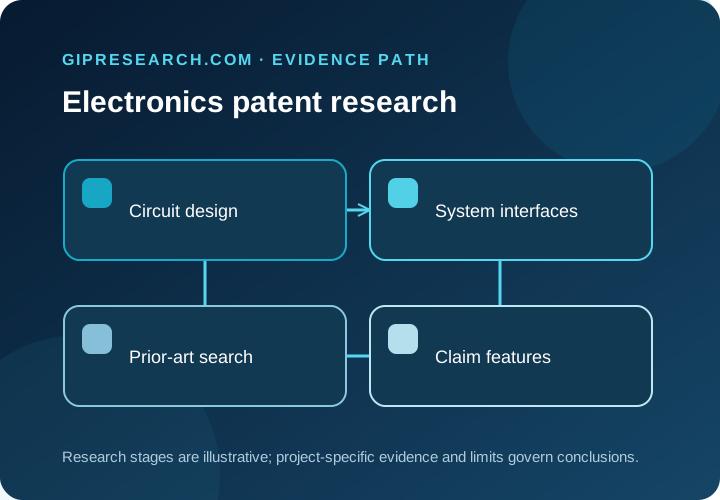
How to File a Patent for Electronics Innovation — research analysis
Define the technical invention within the electronics system
Electronics patent research begins with the actual circuit, device, signal-processing method, architecture or fabrication process that may differ from earlier technical disclosures. Simply combining familiar chips in a consumer product does not automatically produce a patentable invention. Ask what engineering problem was solved and which configuration, signal relationship, timing arrangement, power-control technique or manufacturing step caused the improvement. An invention disclosure should document block diagrams, relevant schematics, operating conditions, component choices, measurements and alternatives. The legal scope of protection depends on the claims issued in a relevant jurisdiction, not on general marketing descriptions of an “innovative electronic device.” The USPTO patent-application guidance identifies the importance of disclosure, claims and necessary drawings.
Distinguish hardware architecture from routine implementation
An electronics project can involve analog front ends, sensors, radio-frequency chains, embedded firmware, semiconductor packaging, photonic components or power management. Each contains potentially distinctive technical relationships and also many established building blocks. If a sensor is arranged in an unusual feedback loop, document the sensor's output, control function, feedback condition and achieved technical effect. If a battery controller changes switching patterns, record timing, operating limits and comparisons. A bare statement that the device is “smart” or “AI-powered” does not establish novelty. A useful research map identifies what is standard infrastructure, what is claimed as new, and which interfaces are essential to obtaining the result.
An electronics-focused prior-art strategy
Start with technical functions rather than a product's popular name. Use engineering synonyms, component terms, waveform descriptions, topologies, materials and relevant CPC/IPC classifications. Prior art may appear in patents, conference papers, datasheets, standards, open hardware descriptions and academic literature. For a wireless sensing system, include antenna design, modulation, signal estimation and network scheduling, not only wearable-device keywords. For semiconductor packaging, search interconnect, heat dissipation and assembly methods. Espacenet provides worldwide patent searching and technical classifications; retain a reproducible log of query strings, date limits, languages and review decisions. The output should identify close technical references and explain why they are close.
Claim architecture for a real device
A device claim might specify a sensing unit, processor, memory, actuation subsystem and their functional relationships. A method claim could describe signal acquisition, filtering, feature generation and control decisions in a defined sequence. Where appropriate, the same disclosure may support apparatus, system or computer-readable-medium claims, subject to local patent law. Broad labels are inadequate without enabling technical detail. The research-stage feature chart should therefore separate mandatory components, optional variants, interconnections and performance conditions. For each claim concept, identify the corresponding figure or embodiment that supports it. A strong claim map also anticipates competitor substitutes and asks whether an asserted advantage depends on the complete combination or only on one subassembly.
Technical effects and measurable evidence
Describe improvements in physical or engineering terms: reduced latency, lower noise, energy efficiency, improved thermal behaviour, increased precision, lower error rate or more robust operation under defined conditions. Each improvement needs a baseline and test method. A claimed reduction in power consumption should identify workload, voltage, temperature and measurement apparatus. A better radio link may require channel model, antenna configuration and interference assumptions. Inventive-step arguments are stronger when an unexpected technical relationship can be tied to reliable evidence; subjective adjectives or unverifiable benchmarks are weak. The analysis must also acknowledge tradeoffs, such as a circuit that improves accuracy while increasing component count or manufacturing complexity.
Embedded software and patent eligibility
A large share of electronics innovation resides in firmware or control software. Patent eligibility differs among jurisdictions, and a digital implementation does not erase the underlying engineering question. In India, section 3(k) of the Patents Act excludes mathematical or business methods, computer programmes per se and algorithms, alongside other statutory exclusions. The assessment must therefore consider the actual claimed contribution and applicable examination practice. A control algorithm connected with a technical system deserves careful characterization; neither “software is always unpatentable” nor “adding a sensor makes every algorithm patentable” is reliable. A jurisdictional memo should identify the claimed hardware/software relationship and its evidentiary support.
Design rights, semiconductor layout and patents are not interchangeable
A product's appearance, a chip-layout topography, a brand and an electronics invention can implicate separate legal protections. A design filing may protect ornamental appearance in certain jurisdictions; patent claims may protect qualifying functional features; semiconductor layout rights and copyright can raise different questions. This distinction matters when deciding what to disclose and how to search. An aesthetic housing shape should not be treated as the same kind of claim as a novel power-conversion circuit. Technical teams should produce separate design images and schematic diagrams for separate IP decisions. If the project has both decorative and functional elements, the report should clearly map which evidence supports which potential protection route.
International filing and ownership issues
The WIPO PCT system offers a coordinated international application process but does not confer one worldwide patent. Decide which markets, manufacturing territories and competitor jurisdictions matter, then consider disclosure, priority and filing strategy with appropriate counsel. Electronics inventions may arise from university collaborations, subcontractors, software teams and chip vendors, making ownership documentation essential. Record inventor contributions, assignment records, confidentiality agreements and public demonstrations. A prototype shown at a conference or a source-code repository can create issues different from an internal confidential test. The research team should document the facts rather than assume that all employee and contractor output is automatically owned by one company.
Patentability versus product-launch clearance
A company may receive a patent on an improved sensor while third-party patents cover the underlying wireless standard, chip architecture or manufacturing method. A patent does not itself grant freedom to operate. The separate FTO workstream should map the planned product and supply chain against live claims in relevant countries, including purchased modules and service-provider components. This is particularly important when a standard-compliant product incorporates multiple layers of proprietary technology. A preliminary patentability search may reveal some such documents, but its purpose and completeness differ from a clearance assessment. A launch decision also involves non-patent regulatory, safety and interoperability requirements outside patent research.
A publishable electronics innovation dossier
The minimum research package contains a dated invention disclosure, circuit or architecture drawings, subsystem description, signal or process flow, experimental protocol, comparative results, prior-art search log, claim-feature matrix, geography and status checks, and a list of open technical questions. An analytical diagram should show how the claimed components cooperate, not merely display a generic circuit-board photograph. A conclusion can recommend refining the claim concept, seeking counsel review, conducting an FTO search or documenting know-how as confidential information. It should not promise that a particular configuration will be granted a patent. This method creates a durable bridge from engineering evidence to patent and commercialization decisions.
Official and primary references
Check the applicability, dates and limitations of cited official materials for your own facts.
This article provides general research information. A reliable project conclusion requires current official records, jurisdiction-specific analysis and verification of the particular documents or facts. Full disclaimer
 How to patent fintech inventions
 Gen AI Innovations
 What is Extended Reality
 How to patent artificial intelligence based innovations
 Patent claim drafting