

L'Oréal surfactant/wax patent — Research and decision guide — research analysis
Patent-specific limitation: historical document identifiers and reported grants are research leads, not confirmation of present ownership, granted claim scope, maintenance or enforceability. Check the official register and prosecution record for the relevant date.
The legacy record cites Indian patent 317652 in connection with an L’Oréal cosmetic formulation combining nonionic surfactants, a water-soluble polysaccharide and a wax containing an ester. That description is a starting hypothesis only. The original claims, exact chemical terminology, applicant details, current ownership and legal status need verification before any reader can infer exclusive rights or technical overlap.
Which specific Indian application and claims can be confirmed?
An analyst should retrieve the specification and separate the compound identities from functional labels. A nonionic surfactant category can include chemically diverse ingredients, and a water-soluble polysaccharide can influence rheology or stability in different ways depending on its structure. An ester-containing wax may affect texture and phase behavior, but the patent cannot be reduced to those broad cosmetic functions. The exact claim language may require narrower ingredient groups, concentrations or preparation steps.
How do surfactants, water-soluble polysaccharides and ester-containing wax relate?
Composition claims must be mapped through their mandatory elements and permitted alternatives. The words “comprising,” “consisting of,” substituent definitions and ranges can create materially different scope. Independent and dependent claims should be separated rather than treated as one summary sentence. A formulation containing a similar emulsifier or wax cannot be described as infringing from ingredient similarity alone; exclusions, numerical limits and other claim elements still require analysis.
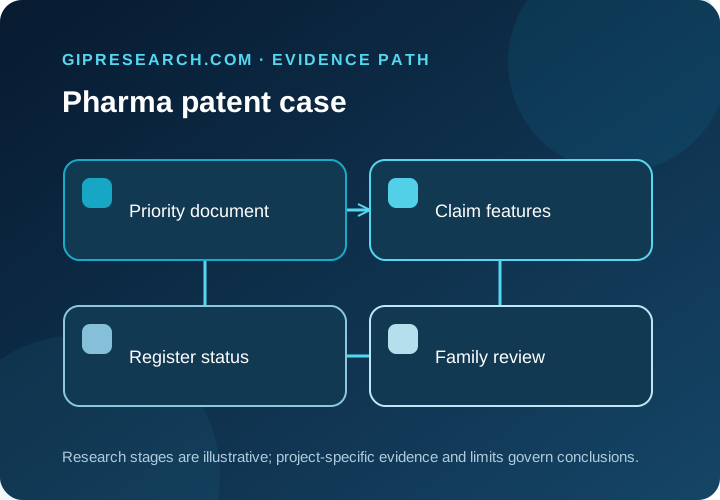
What combinations are covered in independent versus dependent claims?
A scientifically useful comparison should document the complete candidate formulation: ingredient identity, grade, phase, concentration, preparation order, temperature, final pH and stability test. The patent analysis then asks which of those facts correspond to claimed features, not whether the finished product looks similar on a shelf. Publicly available cosmetic composition literature and other patent families help identify prior solutions; they do not determine the legal scope of the Indian patent.
What is known about historical grant and current register events?
The status review should distinguish historical grant data from the present register. Relevant events may include amendments, maintenance records, assignment, opposition or court proceedings; the existence of each event must be confirmed before it is reported. Different jurisdictions may grant different claims for related formulation disclosures, so family searches should record both common priority and country-specific claim text instead of assuming that a foreign version mirrors the Indian protection.
Which formulation variables require FTO search?
For a freedom-to-operate exercise, an ingredient substitution might address one limitation but introduce other patents. The correct workflow begins with a formulation bill of materials, then searches claim features and related families by market, checks active status and conducts a documented element-by-element comparison. For an innovation assessment, the starting point changes: the question is whether a new formulation or processing step is novel and non-obvious relative to disclosed prior art.
Original comparison or decision framework
The original information-gain opportunity is an ingredient/function/claim-element grid and a formula-development decision map. At this drafting stage the grid must label candidate variables as research axes, not as actual elements of patent 317652 until the primary patent document has been checked.
Case-specific analytical application
Formulation data required for meaningful comparison
A cosmetic-formulation comparison begins with an ingredient-level research sheet rather than a product name. Record INCI or chemical identity where available, supplier grade, concentration, water content, emulsification order, temperature profile, viscosity and stability observations. These are the data that may distinguish a nominally similar product from an actual chemical composition described in a patent. However, an experimental formula still must be mapped to the specific claim language. A proprietary mixture may contain multiple surfactants, so the analyst should avoid inferring each one from a generic product-category description or label.
Range interpretation and alternative embodiments
Numerical ranges deserve particular care. A patent may distinguish ingredients by a threshold or combination; formulations at the edge of a range require precise concentration and measurement records. The existence of an experimental example also does not mean every disclosed embodiment was separately claimed or granted. A reader comparing alternatives should ask what the independent claim requires, what dependent claims add and which configurations are found only in the description. An editable matrix separating these three categories provides information gain without incorrectly asserting that the full disclosure has uniform legal effect.
How to state a result when primary patent records are unavailable
A responsible article can explain the technical problem, the identity stated in the archived source and the method of evaluating the relevant document without certifying that all key facts have been checked. Use three explicit evidence states: confirmed from an original patent-office record, reported by an archived secondary source, and not yet verified. A blank or inaccessible register field should be recorded as an information gap, not treated as evidence of lapse, non-ownership or lack of protection. The distinction matters especially for older granted patents, where ownership transfers or post-grant events may change the present picture.
The analysis should conclude with the next specific documents needed: complete claims, patent specification, prosecution history, official legal-status information and dated materials describing the comparison technology. A later expert review can test whether an individual independent claim maps to a real product, but that is a separate engagement with a separate evidentiary threshold. Patents are territorial, and an apparently related foreign publication may have non-identical claim language. The published page should be useful as a technical research guide even before those documents are secured.
Evidence integrity and practical application
Evidence-grade decision. The historical number 317652 is an identifier supplied by the archived WordPress article, not a completed live-register result. The reader should request a patent publication and a dated legal-status extract before relying on a statement of rights. The initial analysis can describe the technical questions and build a source register, but a blank claim chart must remain explicitly blank where the primary claims have not been inspected. Treat a company press release, a search-result snippet and a full patent document as three different evidence grades. A foreign family member is useful only after the priority and application linkage is established.
Decision path. If the objective is competitive intelligence, collect patent-family publications, classification relationships and technical disclosures and label all observed counts by database and date. If the objective is product freedom to operate, obtain implementation-level specifications, search active claims in the intended territories and prepare element-level comparisons. If the objective is patentability of an improvement, define the new technical contribution and compare it with earlier publications. The same historic patent reference can be relevant to all three tasks, but it does not answer them interchangeably.
Editorial limitation. This page does not certify current enforceability, infringement, remaining patent term, family membership or licensing availability. Those conclusions require original records and, where appropriate, jurisdiction-specific professional review. A research consultation can identify what to verify and prepare a traceable analytical report without implying that a patent grant is guaranteed or a commercial outcome has been established.
Primary documents and official research starting points
These references identify relevant records and official tools. Verify current versions, case identifiers and status before making case-specific conclusions.
 How to patent fintech inventions
 Gen AI Innovations
 What is Extended Reality
 How to patent artificial intelligence based innovations
 Patent claim drafting