
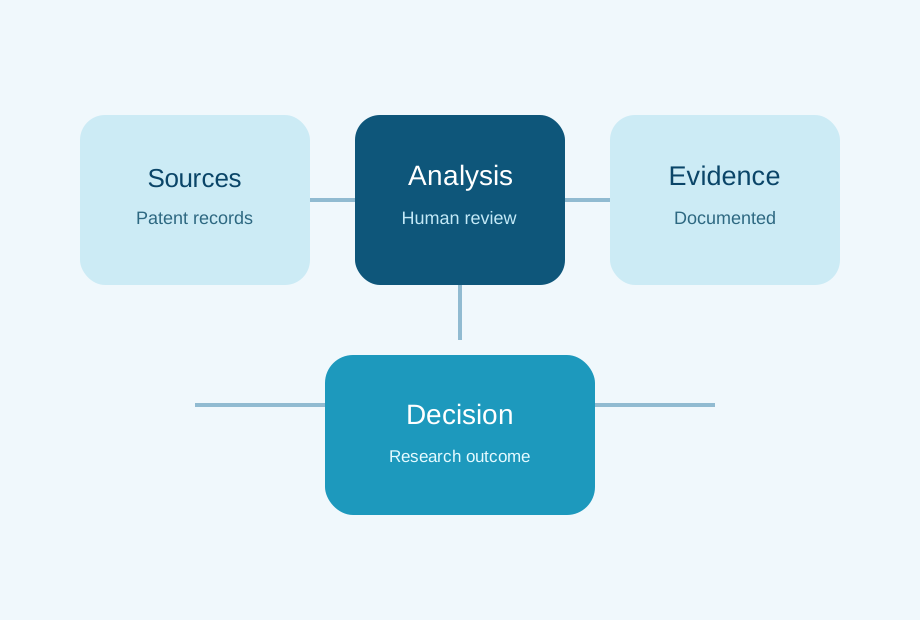
Research and evidence guide
What does a reliable answer require?
The immediate question is practical: A technology leader needs a defensible map of an emerging technical category. The useful outcome is not a generic report or a promise of success. It is a recorded decision base containing clear agentic-ai technology boundaries, relevant patent and research evidence sets, and companies and unresolved technical questions to monitor. A reasonable study may use agentic ai capability taxonomy and patent search/ipc-cpc strategy as its starting records. The exact format, completeness, geographic coverage and professional responsibility must be confirmed before any engagement is described as available. That boundary lets readers distinguish useful preliminary evidence from a result that only a qualified professional or properly tested system can establish.
Define agentic behavior in technical terms
The phrase agentic AI can include very different systems: a language model with tool access, a planner coordinating steps, a multi-agent orchestration layer or a rules engine described in marketing as an agent. Establish inclusion tests for goal-directed execution, tool calls, state management, planning, feedback and constrained autonomy. Keep simple text generation and ordinary automation separate where they lack the target features. Without an explicit boundary, a patent landscape may count almost any recent machine-learning document as agentic.
Search both patents and technical publications
Technical implementations may appear first in academic papers, software documentation or standards discussions, while patent applications are often published later. Construct queries for concrete mechanisms such as tool selection, memory retrieval, execution monitoring, task delegation and error recovery. Search across relevant patent classes and non-patent sources with recorded dates. Patent text and product documentation should be compared at the mechanism level. A company claiming to use agents does not mean it owns a patent on that feature.
Normalize applicants and technology stacks
A foundation-model provider, orchestration-framework developer and enterprise integrator occupy different positions in a technical stack. Their patent portfolios may address model architecture, workflow coordination, interface security or applied business processes. Normalize applicant names and identify portfolio family relationships before making comparisons. A heatmap with axes for actor type and technical mechanism is more informative than raw document counts. When an assignee relationship is uncertain, keep it unmerged and label the limitation.
Look for safety and reliability limitations
Agent workflows introduce practical questions about tool permissions, unwanted actions, contextual memory, source quality and recovery from failed steps. Technical claims about safety or autonomy should be interpreted alongside published system evaluations, not taken from patent abstracts alone. Record whether a document proposes a technique, demonstrates a prototype or reports a reproducible test. NIST's risk-management approach can provide a complementary governance lens, but it does not certify individual products or inventions.
Avoid predictive market-share assertions
An emerging patent cluster can suggest where research is occurring, but publication lag and classification ambiguity limit inference. Some firms publish papers and software without filing patents; others patent aggressively without shipping corresponding features. A robust landscape labels company observations by source, date, filing family and demonstrated behavior. The practical output is a map of disclosed techniques and questions for future monitoring, not a list of unsupported global leaders or revenue forecasts.
A practical seven-step checklist
- Define what counts as an agent. Choose inclusion criteria for planning, tool use, memory and autonomous execution.
- Separate planning, memory and tool-use claims. Separate foundation-model research from orchestration and application mechanisms.
- Identify candidate patent classes. Search technical classes plus concrete engineering phrases in patent records.
- Search inventor and applicant names. Normalize applicant groups and inspect subsidiary mappings rather than name-matching blindly.
- Compare published claims with system behavior. Compare what patent claims disclose with documented technical behavior and evaluations.
- Cross-check academic research. Look beyond patents to papers, standards and technical documentation.
- Track emerging technical limits. Track missing safety, reliability and data-quality evidence as research questions.
How to compare options without overclaiming
The following is a proposed comparison structure, not a set of completed empirical findings. It clarifies foundation model vs agent framework vs tool-using workflow and makes the relevant distinctions inspectable. Each line requires its own source record and a review date before a factual assertion can be published. When two methods or organizations are not comparable, explain the mismatch rather than forcing them into one numeric ranking.
| Evidence category | What to inspect | What cannot be assumed |
|---|---|---|
| Foundation model | Text and inference capabilities | Not necessarily autonomous |
| Agent framework | Tool coordination, memory, planning | Must test actual behavior |
| Deployed workflow | Task-specific system integration | May involve unrelated patent mechanisms |
Two original analytical tools to develop
Framework A — Agentic-specific inclusion/exclusion taxonomy. Specify the unit of analysis, input document fields, selection rule, provenance, last-check date and relevant counterpart or technical feature. Build it as an auditable matrix, leaving unknown cells open. This is a proposed work product until real records are gathered; no patent findings, vendor tests or market statistics are asserted here.
Framework B — Patent/technical-paper cross-source map. Add the conflicting evidence, alternative explanation, status of verification, reviewer and action needed to resolve the matter. Use an explicit 'not established' label when necessary. A decision-support document becomes more useful when it shows limits as clearly as supporting results.
Primary-source grounding and interpretation
Patent information can support systematic searches, family comparisons, citations and technical trend analysis, but coverage and interpretation depend on the collection and the question. WIPO's patent-analytics resources describe the use of patent data for research and innovation decisions, while the EPO documents the scope and limits of Espacenet. The EPO explicitly warns that Espacenet is not a bulk automated retrieval service; any systematic collection must use permitted methods and applicable access terms. See WIPO — Patent Analytics; EPO — Espacenet patent search. These authoritative explanations support a method, not any unverified conclusion about the particular invention, firm or patent under study.
What does the evidence not establish?
A useful reporting format therefore starts with a precisely identified question, makes the underlying sources easy to inspect, and states what the evidence cannot establish. One proposed analytical aid is a agentic-specific inclusion/exclusion taxonomy; a second is a patent/technical-paper cross-source map. Neither should be populated with imagined patent numbers, providers, results, partner interest or trial statistics. Instead the first record should identify its unit of analysis, data collection rule, source link and review date; the second should preserve contradictory findings and missing data. These original frameworks can add decision value only after their cells are filled from actual reviewed source material. The immediate working rule is: Avoid fabricated patent shares, patentability conclusions, and unsupported market-leading rankings. A reader should leave knowing which part of clear agentic-ai technology boundaries is evidence-supported, what remains a research hypothesis and which issues need additional professional or technical review. Where the necessary sources cannot be obtained, the correct result is 'insufficient evidence,' not a polished but unsupported conclusion.
Relevant sources and related research
- WIPO — Patent Analytics — starting-point source; recheck the current version before final publication.
- WIPO — PATENTSCOPE — starting-point source; recheck the current version before final publication.
- EPO — Espacenet patent search — starting-point source; recheck the current version before final publication.
- Related existing GIPResearch research
- Related existing GIPResearch research
- Related existing GIPResearch research
Research limitations: This page is informational research and a proposed consultation pathway. It is not a patentability, FTO, trademark clearance or other legal opinion. Verify consequential claims, source coverage and legal status with appropriate qualified professionals. See full disclaimer.
 How to patent fintech inventions
 Gen AI Innovations
 What is Extended Reality
 How to patent artificial intelligence based innovations
 Patent claim drafting