
Enterprise AI knowledge systems: find reliable answers in company research
Your organization has documents, research reports and contracts scattered across teams. Plan a searchable, permission-aware knowledge system that shows the source of each answer and makes errors easier to detect.
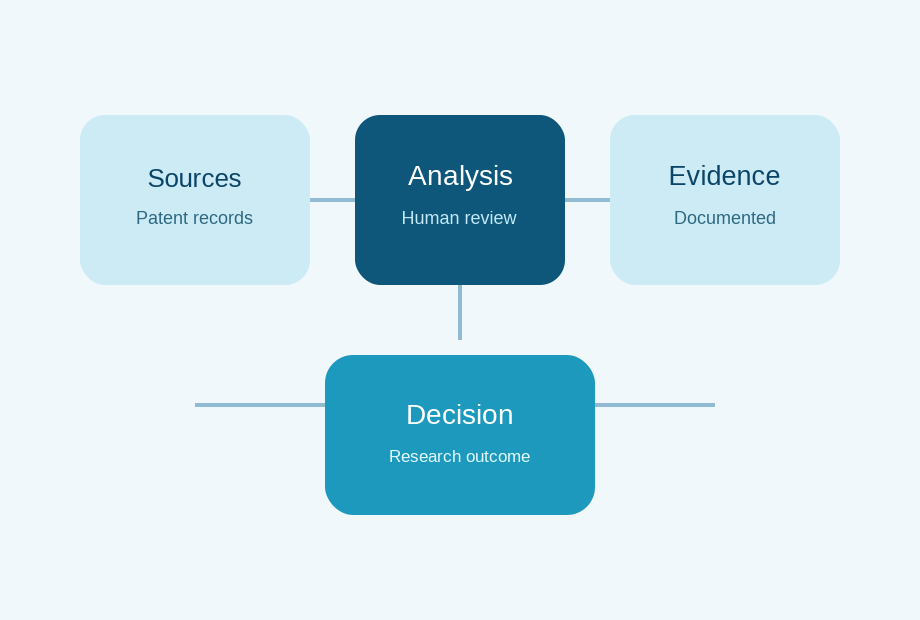
The business problem: answers buried in disconnected files
Research teams often store patents, technical notes, market studies, contracts and vendor documents in separate folders. Employees then search repeatedly or ask general-purpose AI tools to summarize material without a reliable citation path. The challenge is not simply chat access: it is finding the right version of an approved source.
A usable enterprise knowledge system needs a defined audience, permitted sources and decisions it is intended to support. Its primary outcome is accountable access to organizational evidence—not a claim that generated text is true because it sounds plausible.
Start with an inventory of repositories, document owners, confidentiality labels, retention rules, languages and existing search processes. Decide which materials should never be ingested.
What an auditable AI knowledge system should include
Separate document ingestion, text extraction, versioning, indexing, retrieval, access checks, answer generation, human review and feedback capture. Each step can fail differently; testing only the final answer conceals the source of errors.
Retrieval-augmented generation may allow a system to quote retrieved organization documents, but retrieval does not ensure the source is current or authoritative. Return document titles, versions and passage-level references so users can inspect the evidence.
Require access checks at query time and when indexes are updated. A confidential document must not leak into an answer merely because a user can interact with the chatbot. Treat deletion, version retirement and permission changes as explicit acceptance criteria.
Compare three solution patterns
An enhanced document search system can be suitable when employees mainly need to locate records. A retrieval-assisted AI assistant may help summarize dispersed material when every answer is evidence-linked. A specialized workflow application can add approvals, registers and repeatable tasks when the outcome needs more than searching.
Compare them on access control, grounding, document lifecycle, integration effort, data residency, auditability, maintenance and evaluation cost. Avoid choosing an architecture by vendor popularity or a demonstration alone.
For legal and patent files, a human review layer is particularly important. No software choice substitutes for checking current law, original claims or confidential client instructions.
Evaluation and measurable outcomes
Design a test collection of representative questions with expected source documents, including questions that should be refused because the material is missing or restricted. Measure retrieval relevance, grounded answer accuracy, citation correctness, unsupported assertion rate and time to locate the right document.
Run comparisons against the current manual workflow before declaring that the system saves money. Track the evaluation set, model version, permissions and extraction date. An answer with citations can still misstate the cited text.
Use documented thresholds by risk category, not one aggregate score. A marketing research summary may tolerate different error risk than a contractual approval or patent-prosecution task.
Data governance, procurement and phased rollout
Map confidential data classes, approved vendors, processing regions, encryption controls, administrator roles and logs. Review how training use, retention, subcontractors and model updates are addressed contractually.
Pilot with a bounded corpus and a small group of trained users. Define a rollback path if access permissions or citation accuracy fail. Then test the consequences of adding another document repository before broad deployment.
An independent scoping brief can specify the data inventory, retrieval architecture choices, governance controls, evaluation protocol and phased rollout decisions. Such a brief is not a security certification or guarantee of regulatory compliance.
Ten decisions before commissioning an enterprise AI knowledge system
Use this list to assess a proposed product or consultant and protect your organization’s existing research knowledge.
- Which concrete employee task should improve?
- Who owns each source repository and its permissions?
- Which confidential documents must stay out of the index?
- How are outdated versions and deletions reflected in results?
- Will each factual answer carry inspectable document citations?
- How do we test questions with missing or contradictory evidence?
- Which reviewers must approve high-impact outputs?
- How will vendor data usage, storage and retention be checked?
- What manual-workflow benchmark will measure actual value?
- What is the rollback procedure if permissions or grounding fail?
Evidence sources and research enquiry
NIST AI RMF offers a risk-oriented approach for evaluating and governing AI systems; adapt the controls to the organization’s legal and technical obligations rather than treating the framework as a compliance certificate.
The research work can begin with a documented problem statement, a limited document sample, integration constraints and a request for measurable acceptance criteria.
The proposed outcome is a scoped implementation and evaluation roadmap. Confirm available service scope, data handling and the role of qualified legal or security professionals before engagement.
Research sources: NIST AI RMF · WIPO patent analytics · WIPO technology transfer resources
Discuss an independent research scoping brief
Explore related directories: Research by buyer · Technology and geography · Jurisdictions · Research services
Related patent and technology research perspectives
This featured video introduces patent and technology issues. For the specific question on this page, use the documented primary sources and research analysis below.
 How to patent fintech inventions
 Gen AI Innovations
 What is Extended Reality
 How to patent artificial intelligence based innovations
 Patent claim drafting