
Set practical AI rules before your product reaches customers
Set practical AI rules before your product reaches customers? Find the evidence, practical questions and decision steps that matter to startups. Start with a scoped research brief—not promises of patents, rankings or guaranteed revenue.
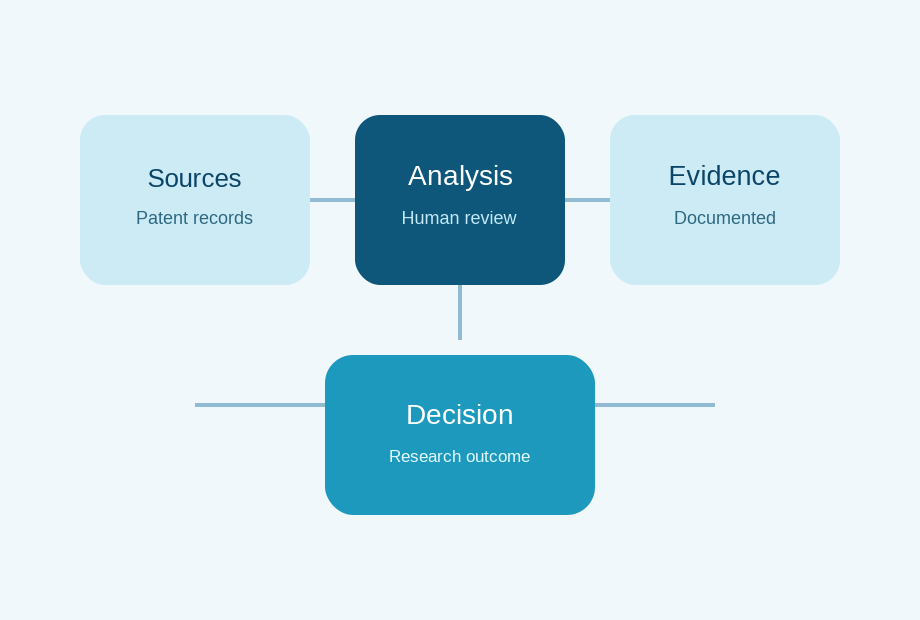
Start with the business decision, not a keyword
Set practical AI rules before your product reaches customers The first question is which decision will change because of this work. An early exploratory search, contract-risk assessment, investment review and ongoing monitoring system need different evidence thresholds. Write down the owner of the decision and the date when findings will be used.
The decision areas are model evaluations, human oversight, data inventory, deployment boundaries and incident logging. They demand different evidence types: official records, primary contracts and applicable policies, technical tests, and validated operational data. The scope should define the product or portfolio, territories, time window and target outcome before tools are selected.
For this subject, Generic policy templates are insufficient for high-impact applications; risk controls must match intended users and actual operating conditions. This limitation should appear alongside every relevant conclusion, not only in a disclaimer at the bottom of the page. Record what remains uncertain and what type of professional review can resolve it.
What evidence is needed and what it cannot prove
Start by separating primary documents, database records, vendor statements and independent testing. For model evaluations, a published claim can identify a research direction but cannot establish enforceability, product performance, legal compliance or likely financial returns.
A practical evidence register should capture source address, document identifier, publication or update date, observation period, relevant jurisdiction and the specific proposition supported. Record missing documents as gaps. When two sources conflict, preserve both with an explicit reason for the discrepancy.
For startups, compare the strength of evidence against the stakes of the decision. Published industry surveys can indicate wider adoption or activity without proving demand for one provider or a specific local service.
Compare the realistic options
One path is internal desk research using official databases and policy records. This can be suitable for early scoping when the question is narrow and researchers document queries. It may be unsuitable when rights, ownership or difficult technical classifications are central.
A second path is an independent commissioned evidence brief with an audit log, documented limitations and review sample. It should specify inclusion and exclusion criteria before results are interpreted. A third path is a qualified specialist engagement when a formal legal position, security assurance or regulated professional opinion is needed.
Do not score options on claimed speed alone. Compare source traceability, repeatability, risk exposure, expertise, completeness and the cost of wrong decisions. Select the option that answers the actual decision rather than the one with the most impressive tool demonstration.
Research methodology and analytics safeguards
Build a source inventory around model evaluations, human oversight, data inventory, deployment boundaries and incident logging. Separate records collected from conclusions drawn. For patent-related analysis, group related applications consistently into families and do not treat every publication as a different invention.
Where numerical analysis is appropriate, document the extraction date, search strategy, inclusion rules, unit of analysis, duplicate handling, quality-control sample and denominator. Display both counts and methodological limitations. Avoid year-over-year trends from incomplete observation periods.
Use a small manual validation sample before summarizing. Check whether selected results really concern model evaluations, whether their dates fit the study window and whether registry status remains current. The resulting chart or table is useful only if another reviewer could reproduce it.
From evidence to a practical deliverable
The proposed output is an AI use-case register, risk scoring worksheet, test protocol and ownership assignments. It should tell the reader which findings are verified, which are hypotheses, who should review unresolved risks and which action follows. A useful report is not a generic collection of definitions.
For multi-jurisdiction projects, distinguish a global overview from rights and obligations in a specific country. An international patent application does not itself create enforceable patent protection everywhere; national register and claims reviews matter.
Confirm who is responsible for interpretation and sign-off. Generic policy templates are insufficient for high-impact applications; risk controls must match intended users and actual operating conditions. If an outcome depends on a contract, formal legal assessment, clinical evaluation or security certification, identify that dependency explicitly.
How to monitor changes after the initial study
Define what would trigger a new assessment: newly published filings, official guidance, ownership changes, vendor revisions, legal decisions or changes in the client’s intended use. The monitoring interval should depend on the decision, not on an arbitrary promise of continuous updates.
Maintain a change log with the prior conclusion, new primary evidence and the analyst’s explanation of whether the decision changed. Do not silently overwrite the old observation because its historical date is part of the audit trail.
Reassess confidence when a source disappears, a patent status record changes, a vendor changes a feature or policy guidance is revised. An evidence brief should be honest about the precise date through which the findings are verified.
Ten questions before you commission this research
Use this decision list to test a proposed research engagement, tool or vendor. Answers should be linked to evidence, not sales claims.
- What concrete decision does set practical ai rules before your product reaches customers support?
- Have we defined the scope including model evaluations?
- Which original records support the central assertions?
- What date does each dataset or official guidance page cover?
- Are the chosen jurisdictions and affected rights identified?
- Are vendor representations separated from independent results?
- Are relevant documents and technical alternatives represented fairly?
- Have we recorded missing or contradictory evidence?
- Will a an AI use-case register, risk scoring worksheet, test protocol and ownership assignments provide an actionable next step?
- Who checks specialist legal, technical or regulatory questions?
Primary sources and independent research enquiry
The starting source for this topic is NIST AI Risk Management Framework. Review the actual publication or current official documentation before making material statements. The links below identify research resources, not confirmation that a commissioned client-specific study has already been performed.
For a scoped enquiry, share the decision, the relevant model evaluations, human oversight, data inventory, deployment boundaries and incident logging, available documents, market boundaries and expected deliverable. Confidential information should be supplied only through an approved secure channel after confirming handling terms.
This guide does not constitute a completed dataset-based analysis, formal professional advice or assurance of a business outcome. Generic policy templates are insufficient for high-impact applications; risk controls must match intended users and actual operating conditions. Confirm the service scope, professional qualifications and evidence standard before entering an engagement.
Research sources: NIST AI Risk Management Framework · WIPO patent analytics guidance · EPO Espacenet · NIST AI Risk Management Framework
Request a problem-focused research brief
Related resources: Research services · Buyer guides · Comparisons · Patent analytics
Related patent and technology research perspectives
This featured video introduces patent and technology issues. For the specific question on this page, use the documented primary sources and research analysis below.
 How to patent fintech inventions
 Gen AI Innovations
 What is Extended Reality
 How to patent artificial intelligence based innovations
 Patent claim drafting