
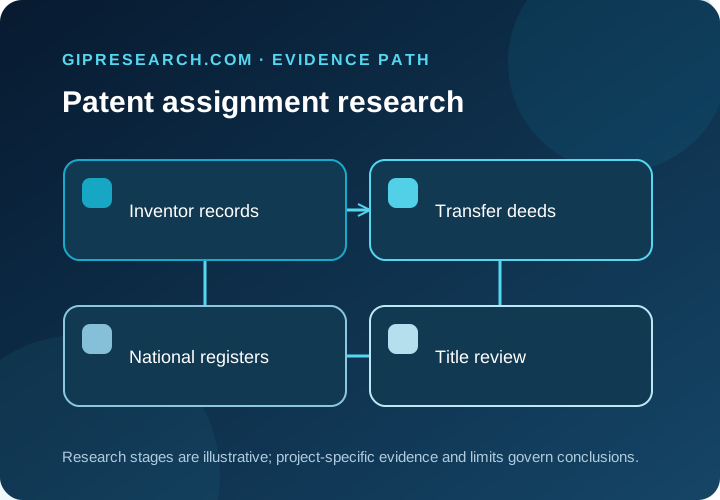
Patent Assignment — research analysis
Assignment transfers patent interests, but evidence matters
A patent assignment is a transaction intended to transfer an ownership interest in a patent or patent application from one party to another. It differs from a license, which generally authorizes specified activity without necessarily transferring title. The distinction has practical consequences for enforcement rights, sublicensing, commercial transactions and who may act before a patent office. A research report should not simply label every exclusive license an assignment or assume every document called an “assignment” operates effectively regardless of law. The relevant assets, parties, jurisdiction and operative language must be examined. In the United States, the USPTO's assignment guidance distinguishes a transfer of ownership from a mere owner-name change.
Confirm exactly what was transferred
An agreement may cover one listed patent, a family, all improvements, pending applications, continuations or future inventions, but these scopes must be stated rather than assumed. Check scheduled patent and application numbers, national family members, inventorship, priority rights and the effective date. A transaction might include know-how or software through separate provisions, yet those assets are not automatically conveyed by listing patent numbers alone. For co-owned patents, identify each party's interest and authority. If the recorded assignee name differs from the operating company, reconcile reorganizations or mergers. A due-diligence table should have columns for asset, jurisdiction, title evidence, transfer instrument, date, recordation and exceptions.
A signed agreement is distinct from recordation
The US Patent Act addresses assignments and recording under 35 U.S.C. §261, discussed in MPEP section 301. The USPTO accepts recordation documents and maintains publicly searchable assignment information. However, the MPEP states that recordation is ministerial and does not itself determine whether the underlying agreement validly transferred title. A data extract is therefore evidence that a transaction was recorded, not proof that all signatures, corporate authorizations and operative provisions were legally sufficient. Analysts should compare the executed instrument to the registry details and flag missing documents. The actual legal effect depends on applicable law and the transaction, not solely on a database field.
Indian statutory requirements are different
Section 68 of the Indian Patents Act requires covered patent assignments and specified other interests to be in writing, with the agreement embodied in a duly executed document setting out relevant rights and obligations. Section 69 addresses registration of assignments, transmissions and other interests, including provisions affecting evidence of title. A transaction that crosses countries therefore needs distinct review for each relevant patent office. A US filing acknowledgment should not be treated as satisfying Indian documentary or registration requirements. The research file should separate formation, legal effect, notice and office recordation under the applicable rules.
Chain of title from inventor to present owner
A credible chain-of-title map begins with the inventor or original applicant and follows executed transfers, employment-related agreements, mergers, reorganizations and subsequent assignments. Check exact entity names, dates and identifiers; differences between parent and subsidiary companies may matter. An invention might have been created during a university collaboration or under a sponsored research agreement that reserves specific rights. Former contractors may have signed confidentiality documents without an effective invention assignment. Each missing link is a potential diligence exception rather than a reason to invent the missing agreement. A record may be free of apparent conflicts and still require underlying contract examination.
Assignment versus license: a decision table
A transaction matrix should compare ownership of the patent, rights retained by the transferor, territory, field of use, duration, sublicensing, enforcement, termination, obligations and recordation. An assignment may transfer an entire ownership interest while an exclusive license can be restricted by field or duration and may allocate enforcement differently. Terms such as “perpetual,” “irrevocable” and “exclusive” should be interpreted in context; they do not automatically confer every incident of ownership. The commercial goal might favor one structure for a technology transfer and another for a distribution arrangement. Patent research can identify the assets and apparent existing interests; counsel should determine legal characterization and enforceability.
Search official records and family members
The USPTO Assignment Center explains how to access recorded patent assignment information. Use patent and application identifiers plus parties' names, then examine reel/frame or corresponding record identifiers when available. Check historical owner names, encumbrances, security interests and corrections. Parallel applications in other jurisdictions may not appear in the same registry, so a global transaction needs a country-by-country title register. The EPO's Espacenet can help identify related family members before local title checks. Save the search date and copies of important records because later name changes or corrections can modify the displayed ownership history.
Assignments interact with financing and enforcement
An assignment used for collateral or a financing arrangement may not operate like a complete sale. Security interests, covenants and contractual restrictions can change who controls licensing or transfer. In litigation, standing and entitlement issues depend on the applicable law, the rights transferred and procedural circumstances. A due-diligence review should also identify pending disputes, prior exclusive licenses and obligations to remit revenue or provide technical support where relevant. The fact that the assignee is recorded does not prove it can freely sublicense all technology or that the patent remains valid. A robust transaction summary distinguishes documentary ownership, current enforceability and commercial rights.
Practical issues in employment and contractor agreements
Modern technology businesses often rely on joint R&D, outsourced software, consultants and university labs. An invention disclosure may name inventors who were never employees of the ultimate patentee. Review actual assignments and company structures, including future-invention clauses and any local rules governing employee inventions. A contract that covers copyright may not clearly transfer patent rights; similarly, a general NDA may protect secrecy without conveying title. In a cross-border deal, legal form and registration obligations can differ from those in the governing contract jurisdiction. The proper research question is which party owned which right at each stage and which instrument demonstrates each transfer.
Deliverable: a traceable patent title dossier
The final research packet should include a complete asset schedule, inventor and applicant identities, prioritized list of assignment instruments, public registry entries, family mapping, material exceptions, license or security-interest indicators, jurisdiction-by-jurisdiction recordation analysis and a concise remediation list. For each exception, state whether the concern is absent documentation, conflicting data, unclear contractual scope or a question requiring legal interpretation. Do not conclude that title is “perfect” merely because public records look consistent. The outcome is a decision-grade documentary map that can support subsequent counsel review, transaction negotiation or portfolio integration. This preserves the core distinction in the legacy article while replacing its oversimplified claim that every assignment is irrevocable in all circumstances.
Official and primary references
Check the applicability, dates and limitations of cited official materials for your own facts.
This article provides general research information. A reliable project conclusion requires current official records, jurisdiction-specific analysis and verification of the particular documents or facts. Full disclaimer
 How to patent fintech inventions
 Gen AI Innovations
 What is Extended Reality
 How to patent artificial intelligence based innovations
 Patent claim drafting