
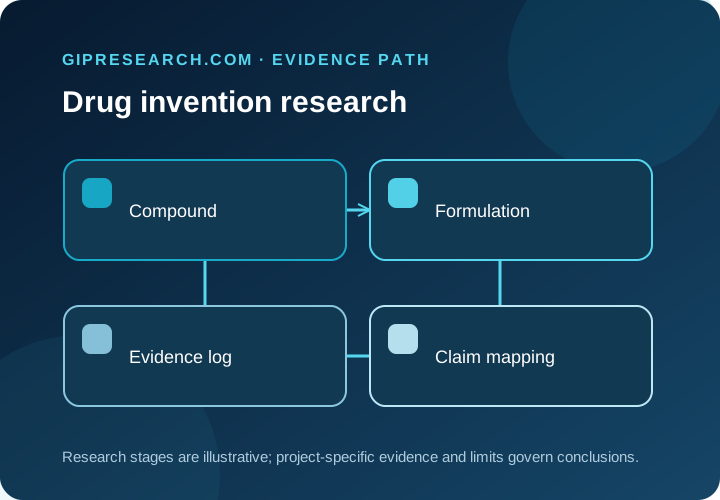
Sumitomo amide compound patent — Research and decision guide — research analysis
Patent-specific limitation: historical document identifiers and reported grants are research leads, not confirmation of present ownership, granted claim scope, maintenance or enforceability. Check the official register and prosecution record for the relevant date.
The original WordPress article attributes Indian patent 316792 to Sumitomo Chemical and an amide compound. Current validity, ownership and the precise chemical genus cannot be certified from that summary. A reliable research draft therefore separates the historical identifier from analysis of compound structure, chemical substitution and the documented uses in the actual patent record.
Which Indian patent and publication are actually involved?
Chemical patents frequently use structural formulas with variables that define a family of compounds rather than one named molecule. A Markush-style claim may specify permissible substituents, linkers, ring systems, salts or stereochemical forms. The significance of each limitation depends on exact structure and chemical definitions. Without the primary claim and formula, it would be irresponsible to assert which amides are covered or excluded.
What compound structures and uses are claimed?
A proper compound chart identifies core scaffold, substituent positions, functional groups, stereochemistry and any conditions in the claimed use or preparation. The same broad term “amide” appears in numerous unrelated molecules. Claims to compositions, methods of preparation and uses should be separated because a technical comparison to one does not automatically answer the others. Drawings and structural representations must agree with the exact source.

How do limitations narrow the independent claims?
Prior-art searching should combine chemical structure retrieval with names, synonyms, classification, biological target information where disclosed, and documented synthesis routes. Text-only search can miss a related compound represented mainly by a figure or a chemical formula. A meaningful novelty analysis identifies the date and disclosure of the closest reference, not simply a later commercial product using a similar ingredient class.
What is documented about novelty and prior art?
An experimental example may report activity, yield or purity under specific conditions, but the presence of data in a patent does not independently validate commercial efficacy or safety. Distinguish experimental claims, corroborated research and regulatory authorizations. Never infer that the patent creates permission to manufacture or market a chemical product. Freedom to operate and regulatory compliance remain separate inquiries.
Which chemical searches and freedom-to-operate steps follow?
Confirm the Indian register event history before describing a grant as presently effective. Any family comparison must match priority and exact bibliographic references; claims may differ between countries. For an FTO study, obtain the candidate molecule structures and target markets, search live claims and build a transparent claim-element assessment rather than concluding from a substance name or broad research summary.
Original comparison or decision framework
A structure-focused research matrix should distinguish the claimed scaffold, variable group, example compound, technical disclosure and comparison molecule. The original published figures, not a generative drawing, must supply any specific molecular structure used in a later version.
Case-specific analytical application
Structural-search reasoning for chemical patents
A keyword such as “amide” is too broad to delimit an invention. A useful search may combine exact chemical structures, substructure constraints, synonyms, formula-derived identifiers and reaction or use terms. But structure searches can produce false positives when stereochemistry or substitutions are handled differently. Record the query definition and visually compare the actual disclosed scaffolds, not only text snippets from indexing services. Such records would help identify compounds near the boundaries of the disclosed genus once patent 316792 is verified.
Disclosed examples versus legal claim scope
A preparation example may demonstrate one member of a compound family under laboratory conditions. It does not show that every molecule covered by broad wording has been separately synthesized or evaluated. Conversely, a claim may cover subject matter beyond the handful of named examples, subject to applicable disclosure rules. The analyst should keep separate tables for claim definitions, experimental examples and external scientific support. That separation is essential before comparing the relevance of a candidate compound or discussing safety and commercial prospects.
How to state a result when primary patent records are unavailable
A responsible article can explain the technical problem, the identity stated in the archived source and the method of evaluating the relevant document without certifying that all key facts have been checked. Use three explicit evidence states: confirmed from an original patent-office record, reported by an archived secondary source, and not yet verified. A blank or inaccessible register field should be recorded as an information gap, not treated as evidence of lapse, non-ownership or lack of protection. The distinction matters especially for older granted patents, where ownership transfers or post-grant events may change the present picture.
The analysis should conclude with the next specific documents needed: complete claims, patent specification, prosecution history, official legal-status information and dated materials describing the comparison technology. A later expert review can test whether an individual independent claim maps to a real product, but that is a separate engagement with a separate evidentiary threshold. Patents are territorial, and an apparently related foreign publication may have non-identical claim language. The published page should be useful as a technical research guide even before those documents are secured.
Evidence integrity and practical application
Evidence-grade decision. The historical number 316792 is an identifier supplied by the archived WordPress article, not a completed live-register result. The reader should request a patent publication and a dated legal-status extract before relying on a statement of rights. The initial analysis can describe the technical questions and build a source register, but a blank claim chart must remain explicitly blank where the primary claims have not been inspected. Treat a company press release, a search-result snippet and a full patent document as three different evidence grades. A foreign family member is useful only after the priority and application linkage is established.
Decision path. If the objective is competitive intelligence, collect patent-family publications, classification relationships and technical disclosures and label all observed counts by database and date. If the objective is product freedom to operate, obtain implementation-level specifications, search active claims in the intended territories and prepare element-level comparisons. If the objective is patentability of an improvement, define the new technical contribution and compare it with earlier publications. The same historic patent reference can be relevant to all three tasks, but it does not answer them interchangeably.
Editorial limitation. This page does not certify current enforceability, infringement, remaining patent term, family membership or licensing availability. Those conclusions require original records and, where appropriate, jurisdiction-specific professional review. A research consultation can identify what to verify and prepare a traceable analytical report without implying that a patent grant is guaranteed or a commercial outcome has been established.
Primary documents and official research starting points
These references identify relevant records and official tools. Verify current versions, case identifiers and status before making case-specific conclusions.
 How to patent fintech inventions
 Gen AI Innovations
 What is Extended Reality
 How to patent artificial intelligence based innovations
 Patent claim drafting