
Trademark prosecution and infringement — Research and decision guide — research analysis
Trademark prosecution and trademark infringement address different legal questions. Prosecution concerns whether an application proceeds to registration under the rules of the relevant office; infringement concerns whether use of a mark violates a protected right. A refusal or objection during examination therefore does not itself establish infringement, and a registered mark does not eliminate the need to analyse particular goods, services, uses and defenses.
What constitutes prosecution before registration?
Before registration, a trademark office may examine distinctiveness, description of goods and services, relative conflicts and procedural completeness. A response to an examination report should identify each ground of objection and the supporting evidence; generic claims about a brand being well known will not answer every objection. In India, the Trade Marks Act and the 2017 Rules govern administrative procedure. The record should include the filing form, specification, examination report, response, evidence and registry status.
Which procedural steps differ from infringement enforcement?
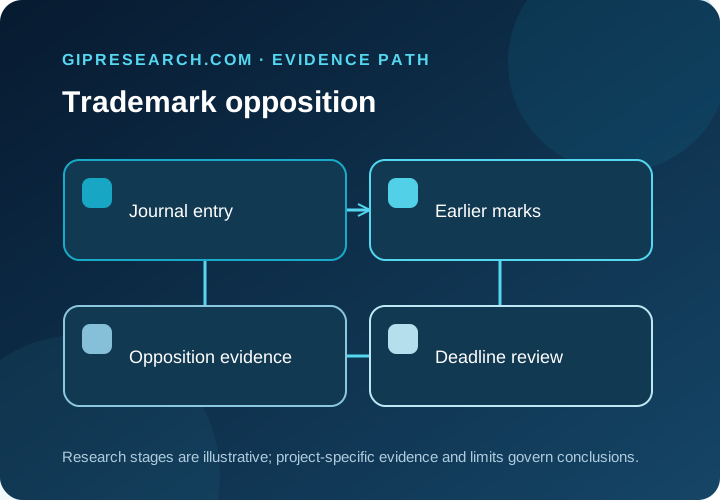
Opposition adds a separate adversarial stage in which a third party challenges an application through prescribed procedures. The evidentiary task differs from ordinary examination: the parties may need records of prior use, reputation, business activity and confusion, subject to jurisdiction-specific rules. A prosecution strategy may therefore involve a narrower specification, a reasoned response or opposition evidence, while a court claim requires a distinct analysis of the legal right and allegedly infringing conduct.

How do searches, objections, opposition and renewal interact?
Infringement is not decided from visual similarity alone. The reviewer should identify the exact mark, registration scope, allegedly challenged sign, marketplace context, class of goods or services, relevant consumers and legal defenses. A search result showing a similar word is a lead for analysis, not an infringement finding. Where unregistered rights or passing off are asserted, the proof framework is different again; the page should clearly label which theory is being discussed.
What evidence and remedies belong to an infringement claim?
Trademark investigation is strongest when a chronological register explains what happened and when. Capture application dates, objections, responses, publication, opposition, registration, renewal and any assignment. A class number is a classification aid, not a universal prediction of confusing similarity. Comparable goods can appear in different classes and dissimilar goods within the same class, so the products and business context need separate treatment.
When is attorney review needed for a specific jurisdiction?
The decision is practical: an applicant facing an office objection needs a prosecution record and response plan; a brand owner facing marketplace imitation needs an evidence-preservation and enforcement assessment. Both benefit from a territory-specific clearance search, but neither should be reduced to a broad promise of successful registration or enforcement. The article can show an evidence-path decision tree without purporting to determine any live dispute.
Original comparison or decision framework
A useful comparison table should contrast administrative examination, third-party opposition, infringement proceedings and passing-off claims by initiating actor, controlling issue, evidence set, procedure and possible outcome. This disambiguates user intent without inventing success rates or legal results.
Case-specific analytical application
Evidence sequence for a contested trademark
Consider a hypothetical application that encounters a citation to an earlier mark. The first response is not necessarily litigation: the analyst must compare the representations of both marks, goods or services, filing history and any evidence bearing on the applicable objection. If the earlier mark has been assigned or its registration status changed, that change may affect the research. By contrast, evidence of actual marketplace imitation requires documents about how the sign is displayed, channels of trade and the conduct complained of. A single search screen cannot establish both sets of facts. The report should make its evidentiary limits visible.
Practical chronology for advisers
A useful case chronology records distinct events: application filing; initial examination; objections; response and hearing if any; advertisement; opposition proceedings where initiated; final registry action; use in commerce; and separately alleged infringement. Document each stage with an official record or authenticated business evidence and do not imply every stage occurs in every application. When a dispute spans jurisdictions, create independent timelines because procedural deadlines and available claims differ. This chronology is an original operational tool: it allows a decision-maker to identify the live procedural problem rather than seeking a generic “trademark protection” service.
The right record for the right procedural question
A credible prosecution review identifies the exact objection, the goods and services as filed, the relevant cited marks and the evidence available at the time the issue arises. An infringement review begins instead with the protected right and the real-world use complained of. Their overlap does not make them equivalent. Search reports should preserve the wording and status of each cited registration rather than summarize all similar signs under a generic risk label.
A business decision may involve narrowing a description, gathering use evidence, defending an opposition or preserving evidence of allegedly infringing conduct. The procedural route determines the relevant forum and documents. Readers should be able to distinguish what the official register establishes from what a party alleges and from what a professional must evaluate. The same commercial brand can have several classes, jurisdictions and ownership histories, each requiring separate verification.
Evidence integrity and practical application
Evidence register. A strong mark-related report distinguishes the application or registration number, owner, classes, dates, journal or status history, marketplace use and documents of any objection or dispute. A trademark class is useful for indexing but not a substitute for comparing actual goods and services. Where the record is incomplete, the report must state the missing evidence and explain why it matters to the decision; a search-result snapshot alone should not be treated as a final rights opinion.
Comparison and alternatives. Preserve the distinction between administrative filings before the registry and rights-based enforcement before the competent forum. Describe the necessary record for each option, the relevant procedural window and the purpose of any supporting evidence. A user seeking a routine register action should not be pressured into an infringement opinion, and a user facing a real marketplace conflict should not assume that renewal alone solves the dispute.
Professional boundary. The procedure discussed is jurisdiction-sensitive and may change with later rules or official orders. The article offers research context, not a conclusion about a particular mark or an assurance of registration or enforcement success.
Primary documents and official research starting points
These references identify relevant records and official tools. Verify current versions, case identifiers and status before making case-specific conclusions.
 How to patent fintech inventions
 Gen AI Innovations
 What is Extended Reality
 How to patent artificial intelligence based innovations
 Patent claim drafting