
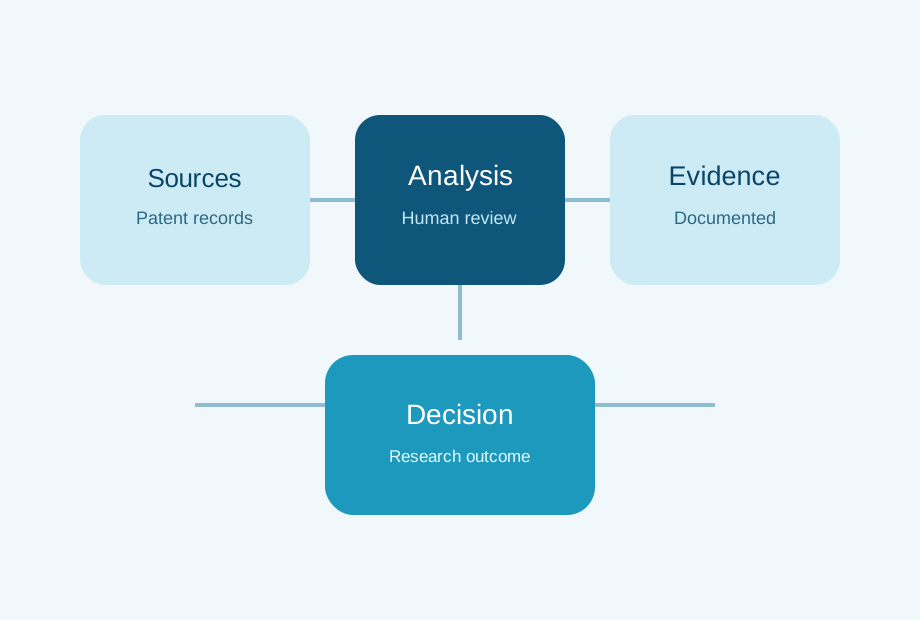
Research and evidence guide
What does a reliable answer require?
The immediate question is practical: Professional users adopt AI while data handling, confidentiality and verification controls remain unclear. The useful outcome is not a generic report or a promise of success. It is a recorded decision base containing risk-based document handling rules, human-review checkpoints, and audit and escalation questions. A reasonable study may use ai use-case and data inventory and risk classification matrix as its starting records. The exact format, completeness, geographic coverage and professional responsibility must be confirmed before any engagement is described as available. That boundary lets readers distinguish useful preliminary evidence from a result that only a qualified professional or properly tested system can establish.
Map where AI tools touch sensitive information
Policies should begin with actual workflows and document types rather than a generic ban or blanket approval. List client correspondence, internal research, patent disclosures, personnel records, publicly available material and contract information separately. Identify whether a system receives complete files, excerpts, embeddings, prompt text or metadata. The distinction matters because privacy and confidentiality risks may arise at different processing stages. An organization should record a named accountable owner for each use case before authorizing routine deployment.
Check the tool and the account actually used
The same vendor may offer consumer and organizational products with different settings and contractual conditions. Record identity controls, access rules, log retention, administrative oversight, model-development use and subcontractor processing where disclosed. Do not rely on a product name alone to infer what data is retained. Independently verify the relevant terms and configuration at the date of review. A procurement questionnaire should identify unanswered issues and escalate them rather than assume all products provide identical controls.
Define human verification duties
An AI-generated reference to a statute, patent, clause or quotation must be checked against the underlying source before consequential use. Build a practical rule describing which outputs may be used as drafting aids and which require specialist review. Include validation of dates, citation identity, jurisdiction, factual omissions and conflicting primary materials. The human reviewer should document what was checked and what remained uncertain. Approval is not a single button; it is a traceable process attached to a defined decision.
Prepare for misuse and incident response
A usable policy anticipates employees entering restricted material in the wrong system, inaccurate AI-generated advice, inadvertent disclosure and retention problems. Specify how an incident is reported, who investigates, whether access must be suspended and how relevant logs are preserved lawfully. Test the procedure on realistic situations instead of assuming a written policy will be followed automatically. Risk management includes practical training, a named escalation contact and periodic sampling of real workflow outcomes.
Revisit rules as technology and law change
AI products, provider terms and applicable regulations change over time. Assign a review cadence to different use cases and make event-driven updates when a model, data-processing arrangement or legal requirement changes. NIST's AI RMF presents governance, mapping, measurement and management as connected activities, not a one-time compliance certificate. Record the rationale behind each permitted or prohibited workflow so the team can update decisions when evidence changes. Do not label a system compliant without jurisdiction-specific verification.
A practical seven-step checklist
- Classify data before use. Classify public, internal, client confidential and regulated information before submission.
- Identify approved tools and accounts. Document permitted accounts, identity controls and who can change tool settings.
- Review vendor terms and retention rules. Confirm relevant data processing and retention terms for the actual product tier used.
- Minimize personal and confidential data. Remove unnecessary personal or confidential content from prompts and uploaded files.
- Require attribution and human verification. Require humans to check statutory, patent, factual and citation claims against originals.
- Record incidents and escalations. Set an incident log, notification route and decision authority for accidental disclosures.
- Reassess policies after product updates. Trigger policy reviews when new models, processing terms or legal duties affect a workflow.
How to compare options without overclaiming
The following is a proposed comparison structure, not a set of completed empirical findings. It clarifies public chatbot vs enterprise tenant vs internally deployed system and makes the relevant distinctions inspectable. Each line requires its own source record and a review date before a factual assertion can be published. When two methods or organizations are not comparable, explain the mismatch rather than forcing them into one numeric ranking.
| Evidence category | What to inspect | What cannot be assumed |
|---|---|---|
| Consumer AI tool | User-facing convenience | Confirm processing settings and permitted data |
| Enterprise tenant | Organizational administration | Contract/configuration review required |
| Internal model | Locally managed components | Security cannot be inferred without tests |
Two original analytical tools to develop
Framework A — Use-case/data-risk decision matrix. Specify the unit of analysis, input document fields, selection rule, provenance, last-check date and relevant counterpart or technical feature. Build it as an auditable matrix, leaving unknown cells open. This is a proposed work product until real records are gathered; no patent findings, vendor tests or market statistics are asserted here.
Framework B — Human-in-the-loop evidence trail template. Add the conflicting evidence, alternative explanation, status of verification, reviewer and action needed to resolve the matter. Use an explicit 'not established' label when necessary. A decision-support document becomes more useful when it shows limits as clearly as supporting results.
Primary-source grounding and interpretation
NIST organizes AI risk work around governance, context mapping, measurement and management. Its playbook provides adaptable suggestions rather than a mandatory compliance certification. Those principles are relevant when evaluating professional document workflows, retrieval systems and vendors because a compelling demonstration does not settle access, accuracy or accountability questions. See NIST — AI Risk Management Framework; NIST — AI RMF Playbook. Actual tool capabilities and data handling require the applicable product version, contract, configuration and controlled tests. The material below proposes how to investigate them; it does not certify an implementation.
What does the evidence not establish?
A useful reporting format therefore starts with a precisely identified question, makes the underlying sources easy to inspect, and states what the evidence cannot establish. One proposed analytical aid is a use-case/data-risk decision matrix; a second is a human-in-the-loop evidence trail template. Neither should be populated with imagined patent numbers, providers, results, partner interest or trial statistics. Instead the first record should identify its unit of analysis, data collection rule, source link and review date; the second should preserve contradictory findings and missing data. These original frameworks can add decision value only after their cells are filled from actual reviewed source material. The immediate working rule is: No blanket assertion of privilege, GDPR compliance, SOC certification or safety. A reader should leave knowing which part of risk-based document handling rules is evidence-supported, what remains a research hypothesis and which issues need additional professional or technical review. Where the necessary sources cannot be obtained, the correct result is 'insufficient evidence,' not a polished but unsupported conclusion.
Relevant sources and related research
- NIST — AI Risk Management Framework — starting-point source; recheck the current version before final publication.
- NIST — Generative AI Risk Management Profile — starting-point source; recheck the current version before final publication.
- Thomson Reuters — Future of Professionals 2026 Legal Report — starting-point source; recheck the current version before final publication.
- NIST — Govern Function — starting-point source; recheck the current version before final publication.
- Related existing GIPResearch research
- Related existing GIPResearch research
- Related existing GIPResearch research
Research limitations: This page is informational research and a proposed consultation pathway. It is not a patentability, FTO, trademark clearance or other legal opinion. Verify consequential claims, source coverage and legal status with appropriate qualified professionals. See full disclaimer.
 How to patent fintech inventions
 Gen AI Innovations
 What is Extended Reality
 How to patent artificial intelligence based innovations
 Patent claim drafting