
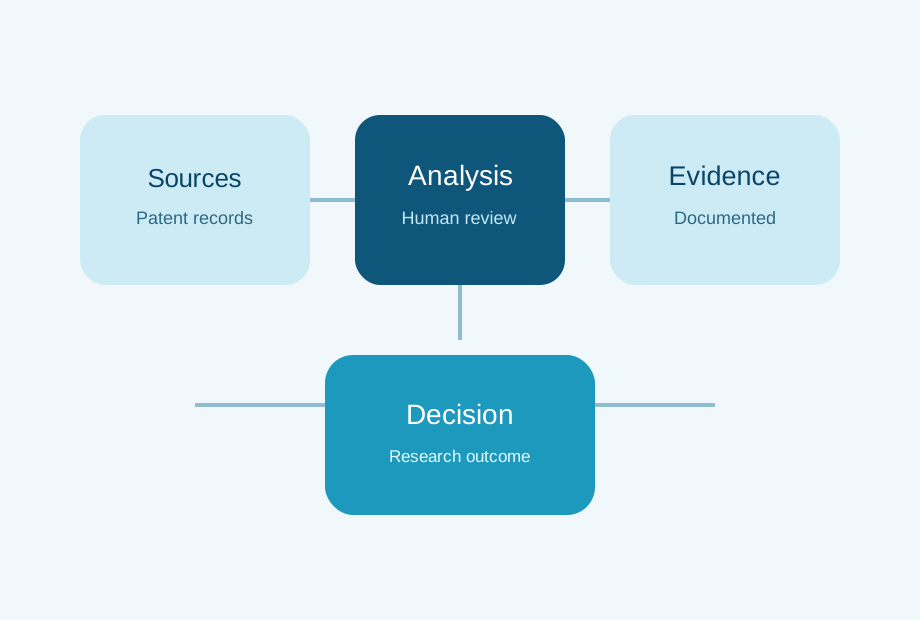
Research and evidence guide
What does a reliable answer require?
The immediate question is practical: A team faces vendor claims without an independent task-based evaluation process. The useful outcome is not a generic report or a promise of success. It is a recorded decision base containing shortlist matched to actual research tasks, explicit comparison criteria, and practical test plan for reliability and privacy. A reasonable study may use task and buyer-needs inventory and evaluation criteria matrix as its starting records. The exact format, completeness, geographic coverage and professional responsibility must be confirmed before any engagement is described as available. That boundary lets readers distinguish useful preliminary evidence from a result that only a qualified professional or properly tested system can establish.
Start with actual work units
A legal AI or patent-research tool cannot be compared meaningfully without defining the jobs users want it to perform. Searching family members, extracting claim limitations, comparing contracts and summarizing regulatory updates have different input and correctness requirements. Create a representative test set for each task, including routine, complex and deliberately difficult examples. Establish what the human reviewer would consider correct before running vendors. A generic productivity demonstration is insufficient evidence that a system works for the organization's own documents.
Separate product categories and data coverage
A patent search database, document-review assistant, specialized drafting platform and general-purpose chatbot may each solve a different portion of a workflow. Compare supported patent collections, jurisdictions, citation exports, document formats, language support and integration methods. A tool can produce an attractive answer while omitting documents outside its source collection. Record which features are documented by the vendor, which are observed in a controlled test and which remain unverifiable.
Test citations against source documents
Accuracy is not just whether an answer sounds plausible. For a research question, inspect whether each key proposition points to a real document and whether the cited passage supports it. Capture omitted evidence, quoted-text errors, irrelevant citations and outdated assertions separately. If a tool provides confidence scores, verify their meaning rather than interpreting the number as a probability of truth. An evaluation rubric must make it possible for another reviewer to reproduce the judgment.
Include confidentiality and operational constraints
Professional tools may differ in data retention, training use, administrator settings, identity integration, export controls and contractual assurances. Some functions require uploading client records or permitting a vendor to process sensitive data. Those decisions belong in a structured governance review, not a marketing feature checklist. Confirm platform settings and contract language directly, and distinguish product configuration from legal compliance. Tool recommendations should never imply that particular legal duties are automatically discharged.
Evaluate decisions, not popularity
A familiar brand or widely discussed model may not be the right choice for a narrow professional task. Design a scorecard with task quality, source traceability, reviewer effort, integration effort, data-control requirements and maintainability. State weighting and missing data. If a critical dimension is unknown, report insufficient evidence rather than filling the gap with a speculative score. Recheck products after significant vendor updates because tested behavior can change.
A practical seven-step checklist
- List the jobs the tool must do. Start with three concrete research tasks instead of a generic AI shopping list.
- Identify required input documents. Gather representative, permission-cleared documents and expected answer criteria.
- Check citation and provenance features. Inspect whether citations identify source and exact passage or only a general link.
- Test with representative research tasks. Run comparable cases across tools and preserve failure examples as well as successes.
- Inspect confidentiality settings and contracts. Review processing agreements, admin settings and confidentiality constraints directly.
- Compare interoperability constraints. Measure whether the tool exports useful evidence and fits the existing research workflow.
- Record unsupported promises and limitations. Keep unsupported vendor promises separate from observed trial results.
How to compare options without overclaiming
The following is a proposed comparison structure, not a set of completed empirical findings. It clarifies patent search tool vs legal drafting assistant vs general ai research assistant and makes the relevant distinctions inspectable. Each line requires its own source record and a review date before a factual assertion can be published. When two methods or organizations are not comparable, explain the mismatch rather than forcing them into one numeric ranking.
| Evidence category | What to inspect | What cannot be assumed |
|---|---|---|
| Specialist patent search | Patent corpora, families, classification | Coverage and jurisdiction limits |
| Legal assistant | Drafting or review within workflow | Task and confidentiality validation |
| General assistant | Broad-language research support | Source-grounding and reliability checks |
Two original analytical tools to develop
Framework A — Vendor capability comparison with dated sources. Specify the unit of analysis, input document fields, selection rule, provenance, last-check date and relevant counterpart or technical feature. Build it as an auditable matrix, leaving unknown cells open. This is a proposed work product until real records are gathered; no patent findings, vendor tests or market statistics are asserted here.
Framework B — Repeatable test-case scoring rubric. Add the conflicting evidence, alternative explanation, status of verification, reviewer and action needed to resolve the matter. Use an explicit 'not established' label when necessary. A decision-support document becomes more useful when it shows limits as clearly as supporting results.
Primary-source grounding and interpretation
NIST organizes AI risk work around governance, context mapping, measurement and management. Its playbook provides adaptable suggestions rather than a mandatory compliance certification. Those principles are relevant when evaluating professional document workflows, retrieval systems and vendors because a compelling demonstration does not settle access, accuracy or accountability questions. See NIST — AI Risk Management Framework; NIST — AI RMF Playbook. Actual tool capabilities and data handling require the applicable product version, contract, configuration and controlled tests. The material below proposes how to investigate them; it does not certify an implementation.
What does the evidence not establish?
A useful reporting format therefore starts with a precisely identified question, makes the underlying sources easy to inspect, and states what the evidence cannot establish. One proposed analytical aid is a vendor capability comparison with dated sources; a second is a repeatable test-case scoring rubric. Neither should be populated with imagined patent numbers, providers, results, partner interest or trial statistics. Instead the first record should identify its unit of analysis, data collection rule, source link and review date; the second should preserve contradictory findings and missing data. These original frameworks can add decision value only after their cells are filled from actual reviewed source material. The immediate working rule is: No claim of partnership, certifications, or tool accuracy without testing. A reader should leave knowing which part of shortlist matched to actual research tasks is evidence-supported, what remains a research hypothesis and which issues need additional professional or technical review. Where the necessary sources cannot be obtained, the correct result is 'insufficient evidence,' not a polished but unsupported conclusion.
Relevant sources and related research
- NIST — AI Risk Management Framework — starting-point source; recheck the current version before final publication.
- Thomson Reuters — Future of Professionals 2026 Legal Report — starting-point source; recheck the current version before final publication.
- WIPO — Patent Analytics — starting-point source; recheck the current version before final publication.
- NIST — AI RMF Playbook — starting-point source; recheck the current version before final publication.
- Related existing GIPResearch research
- Related existing GIPResearch research
- Related existing GIPResearch research
Research limitations: This page is informational research and a proposed consultation pathway. It is not a patentability, FTO, trademark clearance or other legal opinion. Verify consequential claims, source coverage and legal status with appropriate qualified professionals. See full disclaimer.
 How to patent fintech inventions
 Gen AI Innovations
 What is Extended Reality
 How to patent artificial intelligence based innovations
 Patent claim drafting