
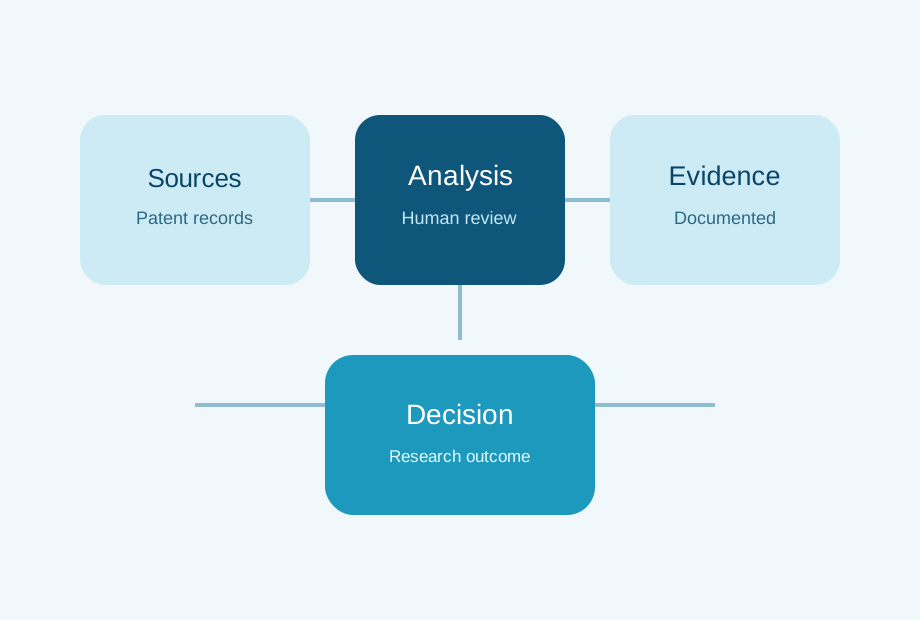
Research and evidence guide
What does a reliable answer require?
The immediate question is practical: Professional teams lose time searching disconnected documents and risk relying on stale material. The useful outcome is not a generic report or a promise of success. It is a recorded decision base containing clear document and permission model, source-linked retrieval design, and test cases for answer accuracy and access rules. A reasonable study may use document-source inventory template and user and access-classification plan as its starting records. The exact format, completeness, geographic coverage and professional responsibility must be confirmed before any engagement is described as available. That boundary lets readers distinguish useful preliminary evidence from a result that only a qualified professional or properly tested system can establish.
Begin with the records, not a chatbot
A private research knowledge system cannot repair source confusion by itself. Inventory document types, repositories, update rhythms, authors, authoritative versions and permissions first. A patent team may hold public publications, private client instructions, legal opinions and draft analyses that must not be mixed indiscriminately. Assign document ownership and retention rules before choosing vector retrieval or model vendors. A well-scoped pilot tests how records are identified and traced, not simply whether a chat interface produces fluent prose.
Distinguish retrieval methods
Keyword search excels when a user knows an exact patent number or defined term; semantic retrieval may help with different wording; answer generation can summarize retrieved material but introduces a new verification step. Compare these methods using the same representative questions and controlled document collection. Require each answer to cite specific documents and locations, and allow the system to say when support is absent. Claims about retrieval accuracy need measured evaluation rather than vendor demonstrations.
Access control must be part of the index
A source-grounded response is still unacceptable if it reveals a document the user was not authorized to read. Specify role boundaries, tenant boundaries, document-level controls and how changes propagate to the search index. Test permission revocation and mixed-sensitivity queries with realistic roles. Caching, embeddings, logs and stored conversations may have separate retention needs. No proposed architecture should be described as secure or compliant until deployment facts, contracts and testing support that claim.
Design provenance into every result
A trustworthy research answer should identify originating file, document version, date, relevant passage and any transformation performed before retrieval. If multiple versions conflict, users need to see that conflict rather than a synthesized compromise. A provenance table can show claim, cited page, source owner, review date and confidence reason. For a legal or technical conclusion, the system must support human inspection of the underlying record. This turns retrieval into a research workflow instead of a convenience feature.
Evaluate failures, not just impressive examples
Pilot testing should include unanswerable questions, conflicting sources, outdated documents, ambiguous terminology, restricted files and deliberately similar filenames. Record false citations, missing citations, access breaches and unsupported synthesis separately. Test reindexing and deletion so a removed or corrected document stops influencing answers. Define an escalation path when evidence is inadequate. A responsible deployment discussion considers monitoring, maintenance and human review—not only initial model choice.
A practical seven-step checklist
- Inventory document types. Catalogue repositories, file types, versions and authoritative owners before ingestion.
- Identify sensitive data and owners. Classify client data, personnel information, private IP and unrestricted research separately.
- Decide hosting and access constraints. Compare cloud tenancy, private hosting, authentication and local-processing constraints.
- Define search and citation requirements. Define when exact search, semantic retrieval or passage-grounded answers are acceptable.
- Test source traceability. Test every important answer against its file, paragraph, date and version.
- Measure retrieval failure cases. Measure false citations, overlooked documents and access-control leakage on realistic tasks.
- Set update and deletion procedures. Specify retention, reindexing and deletion checks with named responsibility.
How to compare options without overclaiming
The following is a proposed comparison structure, not a set of completed empirical findings. It clarifies keyword search vs semantic retrieval vs source-grounded answer generation and makes the relevant distinctions inspectable. Each line requires its own source record and a review date before a factual assertion can be published. When two methods or organizations are not comparable, explain the mismatch rather than forcing them into one numeric ranking.
| Evidence category | What to inspect | What cannot be assumed |
|---|---|---|
| Keyword search | Exact identifiers and expressions | Misses variant phrasing |
| Semantic retrieval | Related concepts and paraphrases | Must show source passage |
| Answer generation | Narrative from retrieved sources | Needs citation and access-control testing |
Two original analytical tools to develop
Framework A — Knowledge provenance architecture diagram. Specify the unit of analysis, input document fields, selection rule, provenance, last-check date and relevant counterpart or technical feature. Build it as an auditable matrix, leaving unknown cells open. This is a proposed work product until real records are gathered; no patent findings, vendor tests or market statistics are asserted here.
Framework B — Role/access/retrieval evaluation matrix. Add the conflicting evidence, alternative explanation, status of verification, reviewer and action needed to resolve the matter. Use an explicit 'not established' label when necessary. A decision-support document becomes more useful when it shows limits as clearly as supporting results.
Primary-source grounding and interpretation
NIST organizes AI risk work around governance, context mapping, measurement and management. Its playbook provides adaptable suggestions rather than a mandatory compliance certification. Those principles are relevant when evaluating professional document workflows, retrieval systems and vendors because a compelling demonstration does not settle access, accuracy or accountability questions. See NIST — AI Risk Management Framework; NIST — AI RMF Playbook. Actual tool capabilities and data handling require the applicable product version, contract, configuration and controlled tests. The material below proposes how to investigate them; it does not certify an implementation.
What does the evidence not establish?
A useful reporting format therefore starts with a precisely identified question, makes the underlying sources easy to inspect, and states what the evidence cannot establish. One proposed analytical aid is a knowledge provenance architecture diagram; a second is a role/access/retrieval evaluation matrix. Neither should be populated with imagined patent numbers, providers, results, partner interest or trial statistics. Instead the first record should identify its unit of analysis, data collection rule, source link and review date; the second should preserve contradictory findings and missing data. These original frameworks can add decision value only after their cells are filled from actual reviewed source material. The immediate working rule is: Do not claim secure self-hosting, data isolation or compliance without verified architecture and contract. A reader should leave knowing which part of clear document and permission model is evidence-supported, what remains a research hypothesis and which issues need additional professional or technical review. Where the necessary sources cannot be obtained, the correct result is 'insufficient evidence,' not a polished but unsupported conclusion.
Relevant sources and related research
- NIST — AI Risk Management Framework — starting-point source; recheck the current version before final publication.
- NIST — Generative AI Risk Management Profile — starting-point source; recheck the current version before final publication.
- Thomson Reuters — Future of Professionals 2026 Legal Report — starting-point source; recheck the current version before final publication.
- NIST — AI RMF Playbook — starting-point source; recheck the current version before final publication.
- Related existing GIPResearch research
- Related existing GIPResearch research
- Related existing GIPResearch research
Research limitations: This page is informational research and a proposed consultation pathway. It is not a patentability, FTO, trademark clearance or other legal opinion. Verify consequential claims, source coverage and legal status with appropriate qualified professionals. See full disclaimer.
 How to patent fintech inventions
 Gen AI Innovations
 What is Extended Reality
 How to patent artificial intelligence based innovations
 Patent claim drafting