
Madrid system fees Breakdown: What You Need to Know — research analysis
What the Madrid System covers
The Madrid System, administered by the World Intellectual Property Organization, provides a coordinated route to request trademark protection in participating jurisdictions. It does not create a single trademark registration automatically enforceable worldwide: each designated member examines the request under its own applicable law. A decision about filing therefore begins with eligibility through an office of origin, the mark and goods or services concerned, and the particular territories where protection is sought. A business should distinguish WIPO's administrative international registration from the substantive rights or refusals arising in designated members. The official WIPO Madrid fee page describes the international-application payment categories and points applicants to current calculations.
Basic fee, designation fee and additional class fee
The WIPO calculation is not a universal one-line charge per country. A Madrid filing has a basic component, and further amounts depend on designated members and the coverage of goods and services. Some members use the standard complementary-fee structure, while others specify individual fees; additional classes may trigger supplementary components under the applicable schedule. The exact outcome depends on which members are designated, whether the mark is represented in colour, the applicable class structure and fee rules at the calculation date. Because these values change, a static article should explain the method rather than reproduce outdated numbers as though they were fixed. The WIPO estimate tool is the appropriate calculation starting point.
Eligibility and the office of origin come before calculation
An applicant generally needs a qualifying connection to a Madrid member and an underlying basic application or registration through a competent office of origin. The international application must align with the qualifying mark and its goods or services within the relevant system rules. That means the fee calculation cannot responsibly be separated from eligibility and specification planning. A company with a wide commercial catalogue may not need all products in every target country; conversely, selecting too narrow a specification can leave important future activities outside the desired protection. Before using a calculator, verify the applicant entity, origin route, exact representation of the mark and classes that correspond to the actual business.
A reproducible fee-estimation workflow
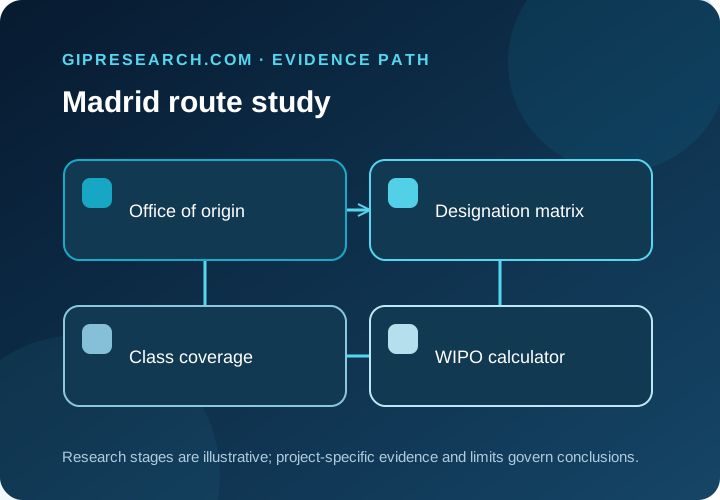
First record the applicant's eligible office of origin and whether the mark is monochrome or in colour. Next prepare a jurisdiction matrix specifying every intended designation and the goods or services for each class. Then check the current WIPO member-specific rules and use the official calculator with the proposed configuration. Save the results with the date, assumptions and applicable currency; international WIPO fee calculations are presented in Swiss francs. Finally identify separately any office-of-origin handling requirements, local refusal-response needs and professional work that may be required. This workflow prevents a common error: quoting a single historical figure without disclosing what it included or excluded.
The number of territories is not the only driver
A request designating a member that applies an individual-fee system may be different from one using standard fee categories. Multiple classes can also affect the outcome. Later designations, subsequent changes, renewals or transfers may involve their own procedures and official charges. A generic assertion that “adding any country is the same amount” is therefore unreliable. The applicant should build a territory-by-class matrix rather than count flags on a map. A decision table can distinguish intended markets, trademark availability research status, business priority, specification, risk of refusal and renewal management requirements. That table is more durable than a dated total that becomes obsolete when one designation changes its schedule.
Protection depends on local examination
Madrid centralizes aspects of the filing and management process, but substantive protection remains jurisdiction-specific. A designation can be refused under local trademark law, including prior conflicting marks or other substantive grounds. The initial stage should therefore include clearance searches in commercially material jurisdictions and an assessment of how the mark translates, is pronounced or is understood locally. A business that relies only on administrative eligibility may face challenges after filing even when every form is accepted. Search and examination costs should not be conflated with guaranteed registration. WIPO's Madrid System guidance describes international fees; local office and counsel requirements must be considered under their own rules.
Class selection affects both coverage and administrative inputs
Trademarks identify goods or services in specified classes, but a class number alone is not an exhaustive description of market activity. A software business might need to consider software goods, hosted services and related consulting, depending on the business model and national practice. A pharmaceutical company may protect goods and separately relevant services. Review actual use, planned expansion and the risk of overbroad claims. The practical decision is not always to include the maximum number of classes; it is to select defensible specifications aligned with the business and intended use. The research team should retain the wording entered into the calculation tool so that future comparisons reflect the same underlying application.
Forecasting amendments, refusals and renewals
An international registration can require subsequent management rather than a one-time filing exercise. Changes in ownership or address, additional territories, renewals and responses to provisional refusals have administrative and legal implications. A strategic budget exercise should describe these possible events as contingencies without suggesting they will occur in every jurisdiction. The relevant filing calendar should separately track the original international registration, each designated member, any provisional refusal deadlines and renewal events. This is especially important after corporate reorganizations, mergers or brand licensing transactions: ownership records, local uses and contractual rights can diverge if the portfolio is not reconciled.
Comparing Madrid and direct national filings
Madrid may reduce paperwork by offering one coordinated international application, yet a direct national filing may be appropriate in some circumstances. Relevant variables include whether a country participates, whether the applicant meets eligibility criteria, local use requirements, planned assignment structures, prior rights and the likely need for substantive representation. An evidence-based comparison should not claim that one route always saves a fixed percentage. Instead, calculate two scenarios for the same jurisdiction set, class coverage and filing period. Identify what the assumptions exclude, such as contested refusal proceedings, translations or specialist legal work, and retain the official source used to calculate each scenario.
Research deliverable and verification process
A reliable Madrid planning file includes applicant identity and origin entitlement, brand representation, target markets, class and specification matrix, preliminary clearance findings, date-stamped official calculation inputs, designation-specific issues and a diary of future events. Use the current official WIPO calculator for amounts rather than static figures that may change, and distinguish official filing charges from professional consulting arrangements.
Official and primary references
Check the applicability, dates and limitations of cited official materials for your own facts.
This article provides general research information. A reliable project conclusion requires current official records, jurisdiction-specific analysis and verification of the particular documents or facts. Full disclaimer
 How to patent fintech inventions
 Gen AI Innovations
 What is Extended Reality
 How to patent artificial intelligence based innovations
 Patent claim drafting